
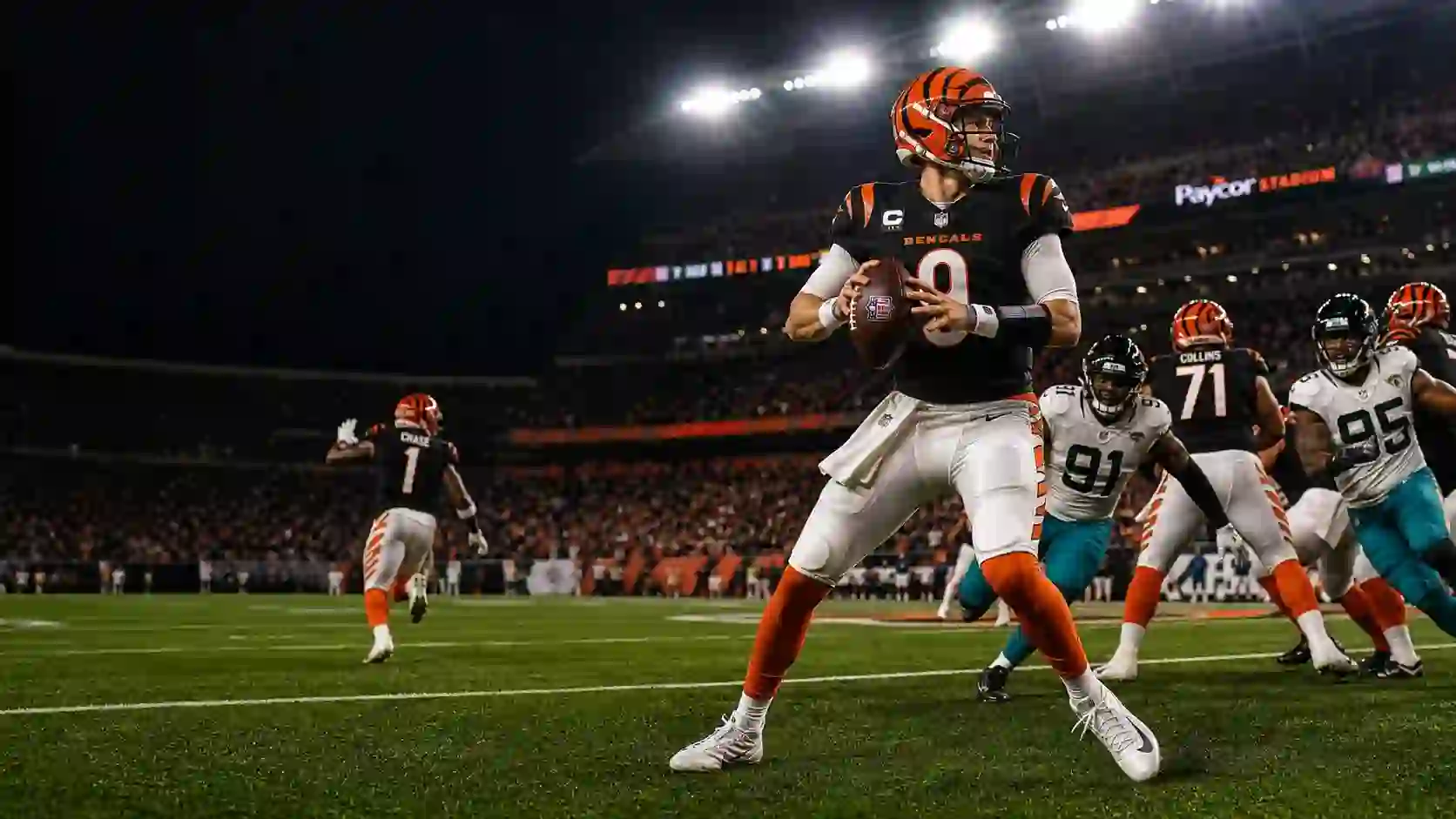
Joe Burrow Leads Bengals Past Dolphins 45-21 in a Week 16 Statement Win
Detailed Biography
| Information | Detail |
|---|---|
| Full Name | Joseph Lee Burrow |
| Position | Quarterback |
| NFL Team | Cincinnati Bengals |
| Jersey Number | 9 |
| Height / Weight | 6 ft 4 in / 215 lb |
| Born | December 10, 1996 (Ames, Iowa) |
| College | LSU (2018–2019) |
| NFL Draft | 2020, Round 1, Pick 1 (Overall No. 1) |
| Pro Bowls | 3 |
| Comeback Player of the Year | 2 (2021, 2024) |
| 2025 Season (8 games) | 173/259, 1,809 yds, 17 TD, 5 INT, 100.7 rating |
Joe Burrow did not just lead the Cincinnati Bengals to a win on Sunday Night Football in Week 16. He dismantled the Miami Dolphins 45-21 at Hard Rock Stadium, delivering one of the most efficient quarterback performances of his career and clinching a 20,000-yard milestone along the way. When the Bengals needed a spark to keep their fading playoff math alive, their quarterback supplied a masterclass in red-zone precision and pocket poise.
Burrow’s 45-21 statement against Miami was as complete an offensive showing as Cincinnati had produced all season. The Bengals moved the at will from the opening drive, scored on every red-zone trip, forced three Miami giveaways, and rode a dominant third quarter to a blowout that turned a neutral-site road game into a home crowd celebration. Forget the record books for a second—this was about how a team functions when every unit clicks on the same night.
The Match Overview
The game kicked off at 8:20 p.m. ET on Sunday, December 21, 2025, in front of a sparse crowd at Hard Rock Stadium in Miami Gardens, Florida. With the Dolphins already eliminated from postseason contention and the fans in attendance hovering around seventy percent capacity, the Bengals brought the only real energy in the building. Cincinnati entered at 4-10, winless on the road against a losing team all season, and left with a 45-21 victory that snapped an ugly road drought in emphatic style.
The Bengals controlled the flow from the second quarter onward. After a 7-7 first quarter and a 17-14 Cincinnati lead at halftime, the visitors exploded for 21 unanswered points in the third quarter to turn a tight contest into a rout. Burrow threw four touchdowns, Chase Brown scored three times, and a healthy Ja’Marr Chase gashed Miami for 109 receiving yards. The 45 points marked the most the Bengals had scored in over a decade, and it all started with the most reliable thing on the roster: their All-Pro quarterback.
Match Overview Table
| Information | Match Details |
|---|---|
| Event | NFL Regular Season, Week 16 |
| Game | Cincinnati Bengals at Miami Dolphins |
| Date | Sunday, December 21, 2025 |
| Venue | Hard Rock Stadium, Miami Gardens, FL |
| Attendance | ~45,000 (approx. 70% of capacity) |
| Winner | Cincinnati Bengals |
| Final Score | Bengals 45, Dolphins 21 |
| Broadcast | NBC (Sunday Night Football) / NFL+ |
Core Match Statistics Overview
| Team Metric | Cincinnati Bengals | Miami Dolphins |
|---|---|---|
| Total Yards | 407 | 389 |
| Passing Yards | 302 | 260 |
| Rushing Yards | 105 | 129 |
| First Downs | 23 | 19 |
| Third Down Efficiency | 6/12 (50%) | 2/10 (20%) |
| Red Zone Conversion | 6/6 (100%) | 2/2 (100%) |
| Turnovers | 0 | 3 |
| Sacks Allowed | 2 | 0 |
| Yards Per Play | 6.7 | 6.7 |
| Time of Possession | 31:32 | 28:28 |
Red-Zone Machine
Cincinnati didn’t just get into the red zone; they turned every single trip into six points. The Bengals finished a perfect 6-for-6 on red-zone drives, with Burrow throwing four of his scores from inside the twenty and Brown punching in a fifth on the ground. Compare that to a Miami offense that reached the red zone only twice, and the discrepancy becomes the entire story of the game.
- Burrow converted on every scoring chance inside the twenty, finishing 4 TD passes on 6 red-zone snaps.
- Miami’s two red-zone appearances yielded exactly two drives, a sign they just could not sustain enough offensive pressure to outscore a red-hot passer.
Clutch Down-Conversion
The Bengals converted 50 percent of their third-down attempts, while the Dolphins managed just two conversions on ten tries. That twenty-point chasm on third down is why Cincinnati controlled the football for over three minutes more and why the visitors never really felt threatened after halftime.
- Burrow moved the chains on six of twelve third downs, keeping drives alive and wearing down the Miami front.
- Miami’s inability to convert third downs forced quick punts and short fields, which handed the Bengals excellent starting position repeatedly.
Ball Security
Cincinnati played a clean game with zero turnovers, while the Dolphins coughed it up three times. A pair of Ewers interceptions and a lost fumble gave the Bengals short fields all night, and Burrow needed only two plays on one of those opportunities to turn a takeaway into seven points.
- The Bengals scored 14 points off of three Miami turnovers, including a 12-yard Brown touchdown just two plays after a fumble recovery.
- The turnover margin of plus-three was the single most decisive split in a game where total yards finished within eighteen of each other.
Explosive Play Balance
Cincinnati gained 302 through the air and 105 on the ground, splitting the workload across pass and run. Against a Dolphins defense that could not generate a sack, Burrow had all day to find his targets.
- Burrow was sacked twice but faced minimal sustained pressure, allowing him to throw with a clean pocket for most of the night.
- The Bengals topped 400 total yards for the second consecutive game, the running game and passing game feeding off each other.
Period-by-Period Analysis
First Quarter
| Score by Quarter | 1 | 2 | 3 | 4 | Final |
|---|---|---|---|---|---|
| Bengals | 7 | 10 | 21 | 7 | 45 |
| Dolphins | 7 | 7 | 0 | 7 | 21 |
- The Bengals opened with a 91-yard scoring drive capped by a nine-yard Burrow-to-Tee Higgins touchdown pass, and Burrow crossed the 20,000-yard career threshold on a 35-yard completion during that march.
- Miami answered immediately when De’Von Achane took a 48-yard run to the house, showing the kind of explosive playmaking that kept the Dolphins in games all season.
- A 14-7 game entering the half never materialized because Cincinnati’s defense forced the first of several critical stops to keep the score from drifting.
Second Quarter
- Evan McPherson nailed a 45-yard field goal to stretch the lead to 10-7, then Miami answered with a nine-yard Malik Washington run to go ahead 14-10.
- Samaje Perine punched in a four-yard touchdown just before the break to send Cincinnati into the locker room up 17-14, a lead built on better red-zone efficiency and a defense that stopped conceding chunk plays.
- The Bengals scored ten points in the quarter on just three possessions, while the Dolphins’ offense stalled after the Washington score.
Third Quarter
- The Bengals scored 21 unanswered points, beginning with a nine-yard Burrow-to-Chase Brown touchdown and a 12-yard Brown run on the very next drive to go up 31-14.
- Burrow connected with Brown again from five yards out with 2:25 left to make it 38-14, capping a 53-yard drive timed perfectly after stopping Miami on downs.
- The quarter turned entirely on the Bengals defense forcing a fumble and a pair of drives that ate clock, allowing Cincinnati to bury the game before the fourth quarter.
Fourth Quarter
- Mike Gesicki’s 17-yard touchdown catch from Burrow pushed the lead to 45-14 with 13:32 remaining, and the starters were pulled soon after.
- Jaylen Wright added a three-yard Miami touchdown with 3:43 left to make the final margin more respectable, but the result was never in doubt.
- Cincinnati’s backups closed out the game, protecting a 45-21 win that reflected total dominance after the break.
Cincinnati Bengals Player Statistics
Joe Burrow (QB)
| Stat | Value |
|---|---|
| Completions / Attempts | 25 / 32 |
| Completion % | 78.1 |
| Passing Yards | 309 |
| Total Touchdowns | 4 |
| Interceptions | 0 |
| Passer Rating | 146.5 |
| Rushing | 2 carries, 6 yards |
Burrow delivered the second-best passer rating of his career and quietly reached 20,000 career passing yards on the opening drive. His four scores extended his streak of multi-touchdown games and gave him a 17-to-5 touchdown-to-interception ratio on a season shortened by injury.
Chase Brown (RB)
| Stat | Value |
|---|---|
| Rushing | 12 carries, 66 yards, 1 TD |
| Receiving | 4 catches, 43 yards, 2 TD |
| Total Touchdowns | 3 |
| Longest Play | 23-yard catch |
Brown was the ultimate dual threat, scoring on the ground and twice through the air to account for three of the team’s six touchdowns. His third-quarter burst through the line for a 12-yard score gave Cincinnati the separation it needed.
Ja’Marr Chase (WR)
| Stat | Value |
|---|---|
| Targets / Receptions | 11 / 9 |
| Receiving Yards | 109 |
| Longest Reception | 36 yards |
| Touchdowns | 0 |
Chase led all receivers with 109 yards and commanded consistent attention, moving the chains repeatedly and setting up short red-zone looks for his teammates. Even without a touchdown, his 36-yard catch was the biggest single gain of the night for the offense.
Tee Higgins (WR)
| Stat | Value |
|---|---|
| Receptions | 3 |
| Receiving Yards | 53 |
| Touchdowns | 1 |
| Longest Reception | 35 yards |
Higgins hauled in the game’s opening score, and his 35-yard grab put Burrow over the 20,000-yard plateau. He averaged 17.7 yards per catch, stretching the field and drawing coverage away from Chase.
Miami Dolphins Player Statistics
Quinn Ewers (QB)
| Stat | Value |
|---|---|
| Completions / Attempts | 20 / 30 |
| Passing Yards | 260 |
| Touchdowns | 0 |
| Interceptions | 2 |
| Sacks | 0 |
Ewers threw for 260 yards but could not find the end zone and threw two critical interceptions that swung momentum. His 20 completions kept the offense moving, yet the lack of red-zone finish and the pair of picks doomed the Dolphins.
De’Von Achane (RB)
| Stat | Value |
|---|---|
| Rushing | 15 carries, 81 yards, 1 TD |
| Longest Run | 48 yards |
| Receptions | 4 catches, 44 yards |
Achane was the brightest spot for Miami, ripping off a 48-yard touchdown and finishing with 125 total yards. He made plays whenever he touched the ball, but his teammates could not keep pace.
Jaylen Wright (RB)
| Stat | Value |
|---|---|
| Rushing | 9 carries, 35 yards, 1 TD |
| Longest Run | 10 yards |
| Touchdowns | 1 |
Wright added a three-yard fourth-quarter touchdown and provided a change-of-pace back behind Achane. He was limited to 35 yards on the ground on one of the few long drives Miami put together.
Malik Washington (WR)
| Stat | Value |
|---|---|
| Rushing | 1 carry, 9 yards, 1 TD |
| Receiving | 1 catch, 6 yards |
| Touchdowns | 1 |
Washington scored on a nine-yard second-quarter run to briefly give Miami a lead. His usage as a gadget piece was one of the few creative wrinkles that worked, but the volume was never enough to sustain a comeback.
Statistical Leaders Summary
| Category | Cincinnati Bengals | Miami Dolphins |
|---|---|---|
| Leading Scorer | Chase Brown (3 TDs) | De’Von Achane (1 TD) |
| Second Leading Scorer | Joe Burrow (4 passing TDs) | Malik Washington / Jaylen Wright (1 TD) |
| Top Passer | Joe Burrow (309 yds, 4 TD, 146.5) | Quinn Ewers (260 yds, 2 INT) |
| Top Receiver | Ja’Marr Chase (109 yds) | De’Von Achane (44 rec yards) |
| Top Rusher | Chase Brown (66 yds) | De’Von Achane (81 yds) |
| Defensive Takeaway Leader | CIN Defense (3 takeaways) | — (0 takeaways) |
Why the Bengals Won and Why the Dolphins Lost
Balanced Offensive Production
Cincinnati did not lean on any one weapon; they spread 313 receiving yards across eight different players and split the rushing attack between Brown and Perine. When Burrow did not have space downfield, he checked down to backs in the flat, and when the defense collapsed on Chase, he exploited Higgins and Gesicki. This is why the Bengals scored 45 points on a night when they only outgained Miami by eighteen yards.
| Metric | Bengals | Dolphins |
|---|---|---|
| Different Receivers with a Catch | 8 | 6 |
| Receiving Yards | 313 | — |
| Passing TD | 4 | 0 |
Efficiency Over Volume
The Bengals turned 61 plays into 407 yards and six touchdowns, a ruthless completion rate that made every drive count. Their 50 percent third-down conversion and perfect red-zone record meant possessions ended in scores rather than punts or field goals.
| Metric | Bengals | Dolphins |
|---|---|---|
| Third Down Conversion | 6/12 | 2/10 |
| Red Zone Conversion | 6/6 | 2/2 |
| Points Per Red-Zone Trip | 6.0 | 3.0 |
Takeaways and Short Fields
Cincinnati’s defense forced three Miami turnovers and turned them into immediate points. On the fumble recovery, the offense needed only two plays to score, demonstrating how turnovers can offset a modest yardage edge.
| Metric | Bengals | Dolphins |
|---|---|---|
| Turnovers Committed | 0 | 3 |
| Points Off Turnovers | 14 | 0 |
Heavy Dependence on Two Players
Miami leaned almost exclusively on Achane and Ewers, and when those two could not finish drives, the offense dried up. Achane accounted for a huge share of the team’s total yards, but the passing game produced zero touchdowns and two interceptions.
| Metric | Dolphins |
|---|---|
| Rushing Yards (Achane) | 81 |
| Passing TD | 0 |
| Turnovers | 3 |
Poor Third-Down Execution
Miami converted just two of ten third downs, and the failures came on short-yardage looks as much as long ones. That inefficiency put the defense back on the field repeatedly and flipped field position against a team already struggling to stop the pass.
| Metric | Dolphins |
|---|---|
| Third Down Conversion | 2/10 |
| First Downs | 19 |
| Time of Possession | 28:28 |
Costly Giveaways
The two Ewers interceptions and the lost fumble all arrived in the second half, turning a 17-14 game into a rout. Miami could not win the turnover battle, and against a quarterback as precise as Burrow, that was fatal.
Historical Context & Advanced Insights
Bengals vs. Dolphins Recent Series
| Date | Venue | Result | Home Team |
|---|---|---|---|
| Sept. 9, 2022 | Cincinnati | Bengals 27, Dolphins 15 | Bengals |
| Dec. 6, 2020 | Miami | Dolphins 19, Bengals 7 | Dolphins |
| Dec. 21, 2025 | Miami | Bengals 45, Dolphins 21 | Dolphins |
Miami still holds the all-time series lead, but the Bengals have won the last two meetings and now own the most lopsided result in the rivalry’s recent history. Cincinnati improved to 1-2 in their last three trips to South Florida, and this victory stands as their biggest over Miami since the modern era began.
Advanced Statistical Insights
The real story of this game lives in the gap between yards and points. Both teams averaged exactly 6.7 yards per play, and total yardage differed by just eighteen yards, yet the final score separated by twenty-four points. That inversion is a textbook example of how efficiency relative to field position, not raw volume, decides football games. Cincinnati turned 50 percent of third downs into new possessions and scored on all six red-zone trips, while Miami converted a fifth of their third downs and reached the red zone just twice. On a per-possession basis, the Bengals scored on far more drives and converted their premium field position into touchdowns rather than field goals.
The turnover margin amplified the gap further. Cincinnati created three takeaways and converted them into fourteen points, all from short fields, while committing none themselves. Had Miami simply protected the football and matched Cincinnati’s third-down rate, the game would have been a one-score contest, but the compounding effect of giveaways and stalled drives turned a close game into a blowout. Ultimately, Burrow’s 146.5 rating and 7.9 yards per attempt illustrate that he faced almost no pressure, and a clean pocket against a quarterback of his caliber is a losing proposition for any defense.
Game Implications & Key Lessons
What This Means for the Bengals
- The 45 points were the most Cincinnati scored in a dozen years, a sign that the offense can still be elite when Burrow, Chase, and Higgins are healthy and on the field together.
- The win kept the Bengals’ slim playoff hopes alive into the final stretch of the season, giving the locker room a reason to compete rather than play out the string.
- Beating a playoff-eliminated opponent on the road stopped a damaging trend of road losses and restored confidence in a team that had been reeling.
What This Means for the Dolphins
- Miami still needs to solve its quarterback situation, as a third straight loss to Cincinnati exposed the gap between a playoff-caliber passer and the current option under center.
- The defense generated no pressure and forced no takeaways, a red flag against a passing attack that only needs a clean pocket to score at will.
- Turnover prevention and third-down offense must be the offseason priority, as the team repeatedly shot itself in the foot with forced throws and stalled drives.
Key Lessons From the Match
- Turnover margin beats yardage almost every time, and Cincinnati proved it by outscoring Miami by twenty-four points despite nearly identical yardage.
- Red-zone efficiency is the single most important scoring indicator, as a perfect six-for-six night translated directly into a blowout.
- A clean pocket is the best weapon a quarterback can have, and Burrow showed what happens when the line holds up.
- Spreading the ball keeps a defense guessing, and Cincinnati’s eight different receivers made it impossible for Miami to game plan around one player.
- Third-down conversion dictates possession, and the Bengals’ fifty percent rate protected a lead that never really looked fragile.
- Explosive plays off turnovers change games in minutes, with the Bengals needing just two plays to turn a takeaway into a score.
Frequently Asked Questions
Who won the game between the Bengals and Dolphins?
The Cincinnati Bengals won 45-21 over the Miami Dolphins on Sunday, December 21, 2025, in Week 16 at Hard Rock Stadium.
How many yards and touchdowns did Joe Burrow throw for?
Joe Burrow completed 25 of 32 passes for 309 yards and four touchdowns with no interceptions, posting a 146.5 passer rating in the win.
Who scored the most for the Bengals?
Chase Brown was the leading scorer with three touchdowns, while Joe Burrow threw four passing touchdowns to lead the scoring throwers.
What were Ja’Marr Chase’s stats in this game?
Ja’Marr Chase caught nine passes for 109 yards on eleven targets, leading all receivers, though he did not find the end zone.
How did Joe Burrow make history in this game?
Burrow surpassed 20,000 career passing yards on a 35-yard completion to Tee Higgins during the first quarter, becoming the fifth-fastest player in NFL history to reach the mark.
What was the key statistic that decided the game?
The turnover margin was decisive, as Cincinnati committed zero turnovers while forcing three, and the Bengals converted a perfect six-for-six in the red zone compared to Miami’s two attempts.
Conclusion
This 45-21 victory was never about which team produced more total yards, because both finished nearly identical in that column. It was about how much each team squeezed out of the opportunities they created. Joe Burrow turned a clean pocket and a full complement of weapons into a near-perfect red-zone night, and his supporting cast rewarded him by finishing drives and protecting the football. Miami, by contrast, wasted a competent yardage day on stalled third downs, two interceptions, and a lost fumble, and those small execution failures compounded into a twenty-four-point margin. On a night when individual talent mattered less than collective discipline, the team that moved the chains and took care of the ball walked away with the statement win.