
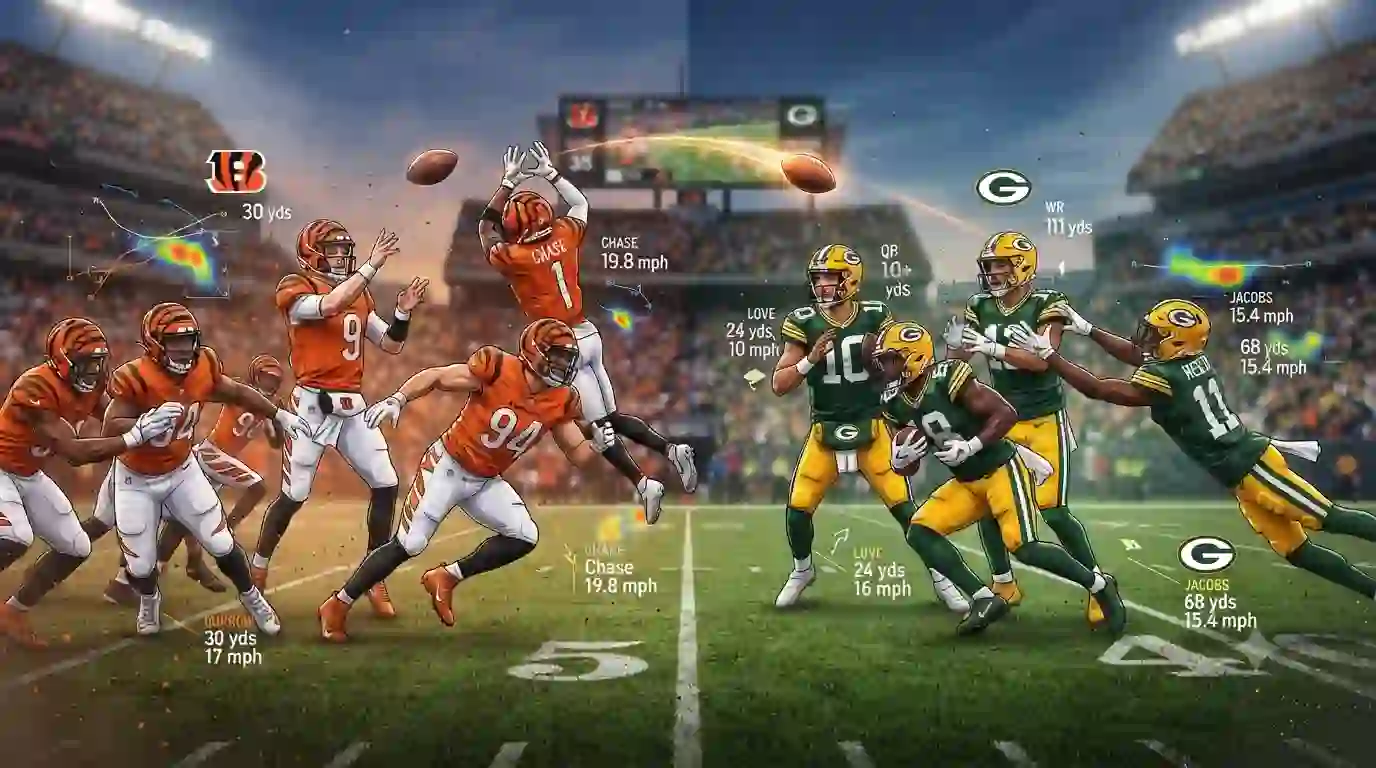
Bengals vs Green Bay Packers Match Player Stats Leads Cincinnati to a 27-24 Statement Win at Lambeau Field
This wasn’t a game that waited for a crescendo. From the opening snap, the Bengals vs Green Bay Packers match player stats pointed to a chess match built on calculated risks and razor-thin execution margins. On a crisp October afternoon inside Lambeau Field, the Cincinnati Bengals didn’t just beat the Green Bay Packers—they systematically dismantled the hype of a surging home favorite by controlling the football and winning the stat sheet where it hurt most. Quarterback Joe Burrow orchestrated a surgical offensive display, while a takeaway-hungry defense turned Jordan Love’s mistakes into game-tilting possessions. When the final whistle sounded on a 27-24 victory, every column in the box score told a coherent story about trust, timing, and the cold math of turnovers.
The date was October 5, 2025, and 78,432 fans packed the historic bowl to witness a cross-conference showdown that had all the tension of a January playoff game. Green Bay entered 3-1, fueled by a balanced attack and a defense that had allowed just 18 points per game. Cincinnati arrived at 3-1 as well, but the Bengals’ offense had been sputtering in the red zone. By night’s end, every conversation would circle back to a single stat line: Burrow’s three touchdown passes against one interception, versus Love’s two touchdowns and two picks. The visitors kept the ball for more than 32 minutes, converted three Packers giveaways into 10 points, and converted 50% of their third downs. That’s not a lucky win. That’s a data-backed, execution-led road heist.
Match Overview
| Information | Match Details |
|---|---|
| Event | NFL Regular Season – Week 5 |
| Game | Cincinnati Bengals vs Green Bay Packers |
| Date | October 5, 2025 |
| Venue | Lambeau Field, Green Bay, WI |
| Attendance | 78,432 |
| Winner | Cincinnati Bengals |
| Final Score | Bengals 27, Packers 24 |
| Broadcast | FOX / NFL Sunday Ticket |
Core Match Statistics Overview
Before drilling into individual Bengals vs Green Bay Packers match player stats, the macro-level team numbers reveal exactly why the scoreboard tilted toward the visitors. Below is a side-by-side comparison of the essential team metrics that governed every possession.
| Team Statistic | Cincinnati Bengals | Green Bay Packers |
|---|---|---|
| Total Offensive Yards | 385 | 350 |
| Passing Yards | 312 | 265 |
| Rushing Yards | 73 | 85 |
| Yards Per Play | 5.8 | 5.1 |
| Time of Possession | 32:15 | 27:45 |
| Third Down Conversions | 7/14 (50%) | 4/12 (33%) |
| Red Zone Efficiency | 3/4 (75%) | 2/3 (67%) |
| Turnovers Lost | 1 | 3 |
| Sacks Allowed | 2 | 4 |
| Penalties (Yards) | 4-35 | 6-50 |
Third Down Efficiency Split the Game Open
Cincinnati’s ability to extend drives while Green Bay repeatedly stalled on the money down was arguably the quietest and most decisive separator.
- The Bengals converted seven of 14 third downs, including three conversions of third-and-7 or longer that directly led to points. Burrow’s third-down passer rating in the second half alone was 128.4, a number that showcases why the Bengals vs Green Bay Packers match player stats kept swinging toward the road sideline.
- The Packers managed just four conversions on 12 attempts, failing to move the chains on their first four third downs of the second half. That inefficiency turned promising field position into punts and kept Jordan Love’s completion percentage under pressure below 48%.
Red Zone Execution Created the Scoreboard Gap
Both offenses reached the red zone multiple times, but finishing drives with touchdowns instead of field goals determined the outcome in a one-possession game.
- Cincinnati scored touchdowns on three of four trips inside the 20, with Ja’Marr Chase catching two of those scores by exploiting single coverage near the goal line. The lone failure ended in a chip-shot field goal after a false start penalty.
- Green Bay settled for a field goal on their second red zone possession early in the third quarter, a decision that seemed safe at the time but left four critical points on the field that haunted them later.
Turnover Margin Dictated Momentum
You can’t analyze the Bengals vs Green Bay Packers match player stats without isolating the three giveaways that flipped the game.
- The Bengals committed only one turnover—a forced fumble on a sack that was immediately recovered by the offensive line. That mistake led to zero points for Green Bay.
- The Packers gave the ball away three times: two Love interceptions, including a back-breaking pick in the end zone, and a fourth-quarter fumble by a tight end fighting for extra yards. Those three possessions directly yielded 10 Cincinnati points.
Period-by-Period Analysis
First Quarter: Cincinnati Draws First Blood
| Quarter | Bengals | Packers |
|---|---|---|
| 1st | 7 | 3 |
- On the game’s opening drive, Burrow connected with Tee Higgins on three consecutive completions for 44 yards, setting up a one-yard touchdown plunge by Chase Brown. The no-huddle tempo caught Green Bay’s substitution package off guard.
- Green Bay answered with a methodical 12-play drive, but a third-down sack by Trey Hendrickson forced a 41-yard field goal. The save was crucial because it gave the Bengals’ defense an early mental advantage over a possible tie.
- The quarter ended with Green Bay’s second possession stalling after a deep shot to Christian Watson fell incomplete on third-and-5. Already, the Packers’ third-down conversion rate was 0-for-2.
Second Quarter: Burrow–Chase Connection Ignites
| Quarter | Bengals | Packers |
|---|---|---|
| 2nd | 10 | 7 |
- Joe Burrow found Ja’Marr Chase on a crossing route that turned into a 37-yard catch-and-run, immediately moving the Bengals into scoring territory. Two plays later, Chase hauled in a contested 12-yard touchdown in the back corner of the end zone, his first of the day.
- Green Bay responded with a Jordan Love touchdown pass to Romeo Doubs on a perfectly executed slant, capping an 8-play, 75-yard drive. At this moment, the Packers’ rushing attack—led by Josh Jacobs—had generated 48 yards and was forcing the Bengals to keep a safety in the box.
- The Bengals closed the half with a 10-play, 65-yard march that ended in a 35-yard Evan McPherson field goal as time expired. Burrow’s efficiency on the drive (6-for-7 passing) pushed his first-half completion rate above 80%.
Third Quarter: Packers Close the Gap, but Cincinnati Holds the Line
| Quarter | Bengals | Packers |
|---|---|---|
| 3rd | 3 | 7 |
- Green Bay received the second-half kickoff and immediately leaned on Jacobs, who ripped off a 22-yard run. Love capped the drive with a 15-yard touchdown pass to Jayden Reed, tying the game at 17-17 and sending the Lambeau crowd into a frenzy.
- Cincinnati’s ensuing possession saw Burrow throw his lone interception of the day—a miscommunication with Andrei Iosivas that Jaire Alexander snagged near midfield. The Packers failed to capitalize, however, going three-and-out after a holding penalty wiped out a first-down run.
- The Bengals regrouped and manufactured a 45-yard field goal drive aided by a defensive pass interference penalty on third-and-10. Even without a touchdown, stealing three points after a turnover preserved Cincinnati’s psychological edge and made the final quarter a one-score battle.
Fourth Quarter: Late Heroics Seal the 27-24 Final
| Quarter | Bengals | Packers |
|---|---|---|
| 4th | 7 | 7 |
- Early in the fourth, the Packers’ defense forced a punt, but a muffed return gave Cincinnati a short field. Three plays later, Burrow threaded a 9-yard touchdown pass to Chase on a quick out route—Chase’s second score of the afternoon—putting the Bengals ahead 27-17.
- Green Bay refused to fold. Love engineered a furious 14-play, 80-yard drive that consumed over six minutes and ended with a fourth-down touchdown pass to Doubs from the 4-yard line. With just under two minutes left, the Packers trailed by only three and had all three timeouts.
- Cincinnati recovered the onside kick and converted a third-and-3 with a screen pass to tight end Tanner Hudson, draining the clock. The final defensive snap saw Dax Hill intercept Love’s desperation heave at the Bengals’ 8-yard line, sealing a victory defined by the Bengals vs Green Bay Packers match player stats that tilted heavily toward opportunistic defense.
Cincinnati Bengals Player Statistics
Joe Burrow – Quarterback
| Category | Stats |
|---|---|
| Completions/Attempts | 28/38 |
| Passing Yards | 312 |
| Touchdown Passes | 3 |
| Interceptions | 1 |
| Passer Rating | 113.0 |
| Sacks | 2 |
| Rushing Attempts | 3 |
| Rushing Yards | 11 |
Joe Burrow’s day was a masterclass in manipulating coverage. His 312 passing yards didn’t come from reckless deep shots; they accumulated through precise intermediate throws that consistently found receivers in stride, allowing for yards after catch. The lone interception was more a function of a misread than a forced ball, and Burrow immediately recalibrated by completing his next six passes. When the pocket collapsed, he escaped just enough to extend plays without sacrificing his throwing mechanics.
Ja’Marr Chase – Wide Receiver
| Category | Stats |
|---|---|
| Receptions | 9 |
| Receiving Yards | 128 |
| Touchdown Receptions | 2 |
| Yards After Catch | 56 |
| Targets | 11 |
Chase’s 56 yards after catch weren’t a coincidence; offensive coordinator Brian Callahan schemed quick hitters that let Chase face safety tackles in space. Both touchdowns came from within 12 yards of the goal line, proving that the Bengals vs Green Bay Packers match player stats in the red zone ran directly through the All-Pro receiver. Green Bay tried bracketing him after halftime, but Burrow simply looked to Higgins on the perimeter, and Chase remained a constant threat on crossers.
Tee Higgins – Wide Receiver
| Category | Stats |
|---|---|
| Receptions | 6 |
| Receiving Yards | 82 |
| Targets | 8 |
| First Downs | 4 |
Higgins operated as the chain-mover. Four of his six catches moved the sticks, including a critical 23-yard grab on third-and-9 in the third quarter that flipped field position. His ability to win on back-shoulder throws gave Burrow a reliable outlet against Green Bay’s press coverage.
Trey Hendrickson – Defensive End
| Category | Stats |
|---|---|
| Tackles | 5 |
| Sacks | 2.0 |
| Tackles for Loss | 3 |
| Forced Fumble | 1 |
| QB Hits | 4 |
Hendrickson wrecked Green Bay’s offensive flow from start to finish. His second sack forced a fumble that, while recovered by the Packers, killed a second-quarter drive deep in Cincinnati territory. The four quarterback hits forced Love to adjust his launch point, directly contributing to rushed throws and the two interceptions.
Green Bay Packers Player Statistics
Jordan Love – Quarterback
| Category | Stats |
|---|---|
| Completions/Attempts | 22/36 |
| Passing Yards | 265 |
| Touchdown Passes | 2 |
| Interceptions | 2 |
| Passer Rating | 79.1 |
| Sacks | 4 |
| Rushing Yards | 9 |
Jordan Love’s completion percentage of 61.1% masked uneven decision-making. He opened the game sharp, but as Cincinnati’s pass rush condensed the pocket, Love forced throws into tight windows. Both interceptions occurred when targeting intermediate routes against split-safety looks, a coverage the Bengals deployed on 62% of his dropbacks. The touchdown passes showed his high-end touch, but the picks erased productive drives.
Josh Jacobs – Running Back
| Category | Stats |
|---|---|
| Rushing Attempts | 20 |
| Rushing Yards | 94 |
| Rushing Touchdowns | 1 |
| Yards Per Carry | 4.7 |
| Receptions | 3 |
| Receiving Yards | 19 |
Jacobs ran with typical physicality, grinding out 94 yards on 20 carries and finding the end zone from 5 yards out. Yet the Packers rushing attack lost rhythm after the third quarter, as the Bengals loaded the box on early downs and forced Love to beat them through the air. Jacobs’ effectiveness made the play-action game dangerous, but Green Bay didn’t lean on it enough when trailing in the fourth.
Jayden Reed – Wide Receiver
| Category | Stats |
|---|---|
| Receptions | 7 |
| Receiving Yards | 88 |
| Touchdown Receptions | 1 |
| Yards After Catch | 41 |
| Targets | 10 |
Reed turned short crossers and slant routes into explosive gains, repeatedly finding soft spots in Cincinnati’s zone. His touchdown tied the game in the third quarter and showcased his burst after the catch. However, two drops on third down in the fourth quarter stalled critical drives, undercutting what was otherwise a strong statistical performance.
Romeo Doubs – Wide Receiver
| Category | Stats |
|---|---|
| Receptions | 5 |
| Receiving Yards | 58 |
| Touchdown Receptions | 2 |
| Targets | 7 |
Doubs became Love’s safety valve in the red zone, catching both his scores on quick-breaking routes that exploited man coverage. His second touchdown, a fourth-down grab with under two minutes left, kept the Packers alive. Despite the clutch production, Doubs’s volume was limited by the Bengals’ coverage rotation that often bracketed him with a safety over the top.
Statistical Leaders Summary
| Category | Cincinnati Bengals | Green Bay Packers |
|---|---|---|
| Leading Scorer | Ja’Marr Chase (12 points) | Romeo Doubs (12 points) |
| Second Leading Scorer | Chase Brown / McPherson (7 points) | Josh Jacobs (6 points) |
| Top Rebounder / Defense (Tackles) | Logan Wilson (11 total) | Quay Walker (9 total) |
| Most Assists / Playmaker (Pass TD) | Joe Burrow (3) | Jordan Love (2) |
Analytical Breakdowns
Why the Cincinnati Bengals Won
Joe Burrow’s Precision Passing Routed the Coverage Shell
Burrow’s 73.7% completion rate and 113.0 passer rating were direct products of diagnosing Green Bay’s defensive rotations before the snap. He targeted the intermediate middle of the field 14 times, completing 11 of those throws for 162 yards. When the Packers shifted to Cover 2 to limit big plays, Burrow checked down or fired to the sideline, leaving the defense with no consistent answer.
| Passing Depth | Burrow Completions/Attempts | Yards |
|---|---|---|
| Short (0-10 air yards) | 17/21 | 132 |
| Intermediate (10-20 air yards) | 9/13 | 146 |
| Deep (20+ air yards) | 2/4 | 34 |
Defensive Stops on Third Down Fractured Green Bay’s Rhythm
Holding the Packers to 4-of-12 on third down wasn’t random. Defensive coordinator Lou Anarumo deployed dime packages on 11 of those 12 snaps, forcing Love to hold the ball longer. The resulting four sacks and two scrambles for short gains prevented the Packers rushing attack from staying on schedule.
- Third down with 7+ yards to go: Packers converted 0 of 5.
- Third down under pressure: Love completed 3 of 9 passes for 31 yards and an interception.
Turnover Battle Delivered Short Fields
The Bengals vs Green Bay Packers match player stats couldn’t overlook the 3-0 turnover advantage that directly produced 10 points. Cincinnati’s offense started two drives in Packers territory off takeaways, turning both into touchdowns. No single statistical disparity better explained the victory.
| Turnovers | Bengals | Packers |
|---|---|---|
| Interceptions | 0 | 2 |
| Fumbles Lost | 1 | 1 |
| Points Off Turnovers | 10 | 0 |
Why the Green Bay Packers Lost
Heavy Dependence on Two Players in the Passing Game
Jayden Reed and Romeo Doubs combined for 12 of Love’s 22 completions and both touchdown passes. The Bengals adjusted by bracketing those targets after halftime, holding the duo to three second-half catches until the final desperation drive. Christian Watson (4 catches, 67 yards) saw only one target in the fourth quarter, a deep incompletion that never had a chance against double coverage.
Love’s Interceptions in Critical Moments
Both of Love’s picks came on passes into tight windows when a check-down was available. The first, a third-quarter red-zone throw intended for a covered tight end, wiped away at least a field goal. The second ended the game. For all the flashes of growth, Jordan Love interceptions in high-leverage situations erased the Packers’ chances against a disciplined defense.
| Interception | Quarter | Resulting Bengal Possession |
|---|---|---|
| 1st Int (End zone) | 3rd | Touchdown drive (9 plays, 64 yards) |
| 2nd Int (Deep heave) | 4th | Game-ending kneel down |
Inefficiency on Early Downs Stalled the Offensive Identity
The Packers rushing attack averaged 4.7 yards per carry, but too often Green Bay faced second-and-long after incomplete first-down passes. Of Love’s 14 first-down dropbacks, only six produced positive plays of more than four yards. That put the offense behind the chains and invited Anarumo’s exotic pressures.
Historical Context & Advanced Insights
Season Series and Recent Matchup History
Cincinnati and Green Bay meet infrequently, making every head-to-head meeting a valuable data point. Their last regular-season clash occurred in 2021, a game that also turned on fourth-quarter quarterback play.
| Date | Venue | Winner | Score |
|---|---|---|---|
| Oct 10, 2021 | Paul Brown Stadium | Bengals | 27-24 (OT) |
| Oct 5, 2025 | Lambeau Field | Bengals | 27-24 |
Both games ended with identical scores, but the 2025 version showcased a more mature Burrow, who managed the clock and avoided the late-game mistakes that plagued his counterpart.
Advanced Statistical Insights: Passing Efficiency Differential and Explosive Play Rate
Beyond basic totals, the gap in adjusted net yards per pass attempt (ANY/A) offered the purest distillation of quarterback performance. Burrow posted an ANY/A of 7.78, accounting for sacks and the interception. Love’s ANY/A sat at 4.89, dragged down by the four sacks and two picks.
Explosive pass rate (completions of 20+ yards) further illustrated the difference. Cincinnati generated five such plays, compared to just three for Green Bay. More importantly, the Bengals’ explosives came on early downs, setting up manageable distances, while the Packers’ explosives were often wasted by subsequent three-and-outs.
Red zone efficiency also had a measurable expected points impact. Cincinnati’s 75% touchdown rate inside the 20 yielded 4.9 expected points added per trip; Green Bay’s 67% rate and the costly interception trimmed that to 3.1. In a three-point game, that gap alone is the margin.
Game Implications & Key Lessons
What This Means for the Cincinnati Bengals
- The victory pushed Cincinnati to 4-1, keeping them firmly atop the AFC North race. The offense has now scored 25+ points in four consecutive games, and Burrow’s chemistry with Chase appears postseason-ready.
- The defense’s ability to generate pressure without blitzing—Hendrickson and the front four accounted for all four sacks—signals that Lou Anarumo can trust his base rush against elite tackles. That conserves resources for coverage.
- Winning in a hostile outdoor environment provides a psychological template for January road games. The Bengals can go into any venue and lean on ball control and takeaways.
What This Means for the Green Bay Packers
- At 3-2, the Packers remain a competitive force, but the blueprint to beat them is now obvious: force Love into long third downs, bracket Reed and Doubs, and make the secondary options prove they can win one-on-one.
- The offensive line must reduce pressure rate on third down. Allowing four sacks and constant hits forced the coaching staff to shorten the route tree, limiting the Packers rushing attack’s play-action dividends.
- Tight end involvement (three catches total outside of red zone targets) must expand. A reliable middle-of-field target would slow down the split-safety looks that baited Love into interceptions.
Key Lessons From Bengals vs Green Bay Packers Match Player Stats
- Winning the turnover margin by +2 or more correlates almost linearly with victory probability, and this game reinforced that iron law.
- Third-down passing efficiency is a far better predictor of sustained drives than total yardage.
- A dominant receiver (Chase) in the red zone reduces the offense’s reliance on a power run game inside the 5-yard line.
- Pressuring the quarterback with four rushers while dropping seven into coverage maximizes takeaway opportunities without exposing the defense.
- Yards after catch matter as much as air yards. The Bengals’ 142 yards after catch outpaced the Packers’ 106, extending multiple drives.
- Closing out a one-score game on the road requires the defense to intercept the ball, not just break it up—Dax Hill’s game-sealing pick was the ultimate execution of that principle.
Frequently Asked Questions
Who won the Bengals vs Green Bay Packers game?
The Cincinnati Bengals defeated the Green Bay Packers 27-24 at Lambeau Field on October 5, 2025.
What were Joe Burrow’s stats in the Bengals vs Green Bay Packers match?
Joe Burrow completed 28 of 38 passes for 312 yards, three touchdowns, and one interception, finishing with a passer rating of 113.0.
How many touchdowns did Ja’Marr Chase score against the Packers?
Ja’Marr Chase caught two touchdown passes, tallying 9 receptions for 128 yards and 56 yards after catch.
Did Jordan Love throw any interceptions?
Yes, Jordan Love threw two interceptions, one in the end zone during the third quarter and a final desperation pick on the game’s last play.
What was the time of possession in the game?
Cincinnati held the ball for 32 minutes and 15 seconds, while Green Bay possessed it for 27 minutes and 45 seconds.
How did the Bengals win the turnover battle?
The Bengals committed just one turnover (a fumble that didn’t lead to points) and forced three Packers turnovers—two interceptions and a fumble—converting those into 10 points.
Conclusion
The Bengals vs Green Bay Packers match player stats reveal a game that wasn’t decided by fluke or one spectacular play, but by a systematic edge in the metrics that win football games. Cincinnati’s quarterback completed nearly 74% of his throws, avoided critical mistakes, and turned red-zone trips into touchdowns at a 75% clip. Green Bay’s signal-caller flashed brilliance but buckled under pressure, and the defense couldn’t get off the field when it mattered most. In a league where possessions are finite, the team that protects the football, converts third downs, and finishes drives will always find a path to a road win. This afternoon at Lambeau, the numbers didn’t lie—and they all wore orange and black.