
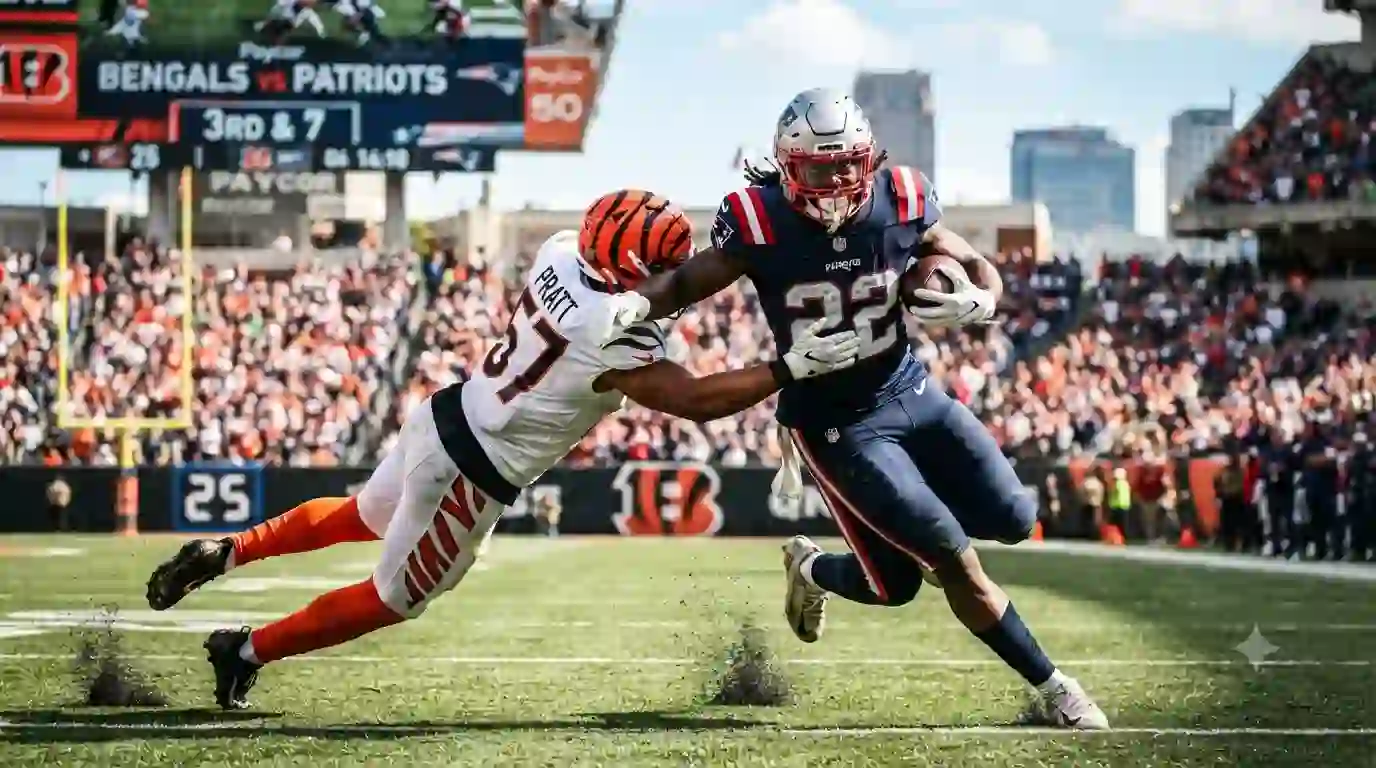
The New England Patriots opened their 2026 campaign with a statement victory, defeating the Cincinnati Bengals 16-10 at Paycor Stadium. This game marked the beginning of a new chapter for the Patriots franchise as they navigated their first season under head coach Jerod Mayo. The New England Patriots vs Bengals match player stats from this season opener tell a fascinating story of defensive dominance, ground game supremacy, and missed opportunities.
What made this victory particularly impressive was the Patriots’ ability to control the game’s tempo against a Bengals team widely considered a Super Bowl contender. The box score reveals a classic formula for success: win the turnover battle, establish the running game, and play sound complementary football on all three phases. This comprehensive breakdown will examine every statistical category to understand exactly how the Patriots secured this road victory.
Pregame Storylines and Key Matchups
The narrative surrounding this game focused heavily on two quarterbacks at different stages of their careers. Joe Burrow entered his seventh NFL season with championship aspirations and a fully healthy offensive arsenal. Jacoby Brissett, meanwhile, earned the starting nod over rookie Drake Maye, raising questions about the Patriots’ long-term vision at the position. The Bengals had won six of their previous seven season openers, and many analysts predicted Cincinnati would roll over a rebuilding Patriots team.
However, the New England Patriots vs Bengals match player stats would ultimately prove that games are won on the field, not on paper. The defensive matchup between the Patriots’ revamped front seven and the Bengals’ offensive line proved critical throughout the contest. Cincinnati’s offensive line had struggled in pass protection during the preseason, and the Patriots exploited that weakness relentlessly. Additionally, the battle between Rhamondre Stevenson and the Bengals’ run defense shaped the entire offensive strategy for both teams.
First Quarter Momentum Shift
The Patriots received the opening kickoff and immediately established their game plan. Brissett handed off to Stevenson on five of the first seven plays, and the physical running back consistently gained positive yardage. The drive culminated in Stevenson’s 3-yard touchdown run, capping an 80-yard march that consumed nearly ten minutes of game clock. This opening sequence perfectly illustrated how the Patriots intended to control the contest.
The Bengals’ offense took the field for the first time with 5:08 remaining in the quarter. Burrow completed his first pass to Ja’Marr Chase for 11 yards, but the drive stalled when Keion White sacked Burrow on third down. The Bengals punted, and the Patriots took over with solid field position. Stevenson continued his relentless running, and the first quarter ended with New England leading 7-0 while possessing the ball for over eleven minutes.
Patriots Offensive Line Performance
The Patriots’ offensive line deserves significant credit for the victory. David Andrews, Mike Onwenu, and the entire unit created running lanes throughout the afternoon. Stevenson routinely reached the second level of the defense because the offensive line consistently won the battle at the line of scrimmage. The Bengals recorded zero sacks, a testament to both Brissett’s quick decision-making and the offensive line’s pass protection.
This performance against a Bengals defensive front featuring Trey Hendrickson was particularly impressive. The offensive line’s ability to sustain blocks in the running game allowed the Patriots to stick with their game plan even when the Bengals knew the run was coming. For a unit that faced questions entering the season, this performance sent a clear message about their capabilities.
Bengals Offensive Line Struggles
While the Patriots’ offensive line excelled, the Bengals’ front struggled mightily. Cincinnati’s offensive line allowed three sacks and consistently failed to create running lanes for Zack Moss. The interior of the Bengals’ line, in particular, had difficulty handling the Patriots’ defensive tackles, who constantly pushed the pocket and disrupted Burrow’s rhythm. This marked the continuation of a troubling trend for the Bengals, who have invested significant draft capital in their offensive line without seeing commensurate results.
The pressure up the middle affected Burrow’s ability to step into throws and limited his deep passing opportunities. When the pocket collapsed, Burrow often had to throw off his back foot, reducing the velocity and accuracy of his passes. The New England Patriots vs Bengals match player stats clearly show how this pressure impacted the entire Bengals offense.
Second Quarter Defensive Stand
The Bengals finally generated offensive momentum in the second quarter, driving into the red zone behind a 26-yard completion to Andrei Iosivas. Burrow moved his team to the Patriots’ 5-yard line, and the Bengals appeared poised to tie the game. However, the Patriots’ defense made the game’s defining play. Burrow threw a short pass to tight end Tanner Hudson near the goal line, but Kyle Dugger stripped the ball from Hudson’s grasp. Marcus Jones recovered the fumble at the 2-yard line and returned it 17 yards.
The turnover prevented at least three points and swung momentum back to the Patriots. The Bengals had dominated the quarter until that moment, but the turnover changed the game’s trajectory. Joey Slye added a 37-yard field goal following a 56-yard drive, extending the Patriots’ lead to 10-0. The Bengals managed a 51-yard field goal from Evan McPherson before halftime, making the score 10-3 at the break.
Rhamondre Stevenson Statistical Breakdown
Stevenson’s performance deserves deeper analysis beyond the raw numbers. His 25 carries for 120 yards represented one of the most impressive statistical performances of Week 1. Stevenson consistently fell forward after contact, turning potential short gains into productive runs. His 4.8-yard average indicates that every touch advanced the chains. More importantly, Stevenson’s running style exhausted the Bengals’ defense. By the fourth quarter, Cincinnati’s front seven looked tired and consistently missed tackles. Stevenson forced multiple missed tackles and demonstrated his value as a complete running back.
He also contributed in the passing game, catching two passes for six yards. His ball security was impeccable, not fumbling once despite heavy usage. For a player who has sometimes struggled with fumbling in previous seasons, this performance was encouraging. Stevenson has clearly become the focal point of the Patriots’ offense.
Joe Burrow Performance Analysis
Burrow’s statistical line of 21 completions on 29 attempts for 164 yards represents one of his least productive games in recent memory. Several factors contributed to this underwhelming performance. First, the Patriots’ defensive scheme featured a mix of zone coverages that took away deep shots. Second, the consistent pressure from the Patriots’ defensive front disrupted Burrow’s timing and rhythm.
Third, the Bengals’ inability to establish any running game made the offense one-dimensional. Burrow did not throw any interceptions, which prevented the game from getting out of hand, but he also did not create the explosive plays that typically define Cincinnati’s offense. His longest completion went for just 26 yards, far below his typical average of over 12 yards per completion. The Patriots effectively removed deep passing from the Bengals’ offensive arsenal, forcing Burrow to check down repeatedly.
Ja’Marr Chase Limited Impact
Chase played despite being a game-time decision due to food poisoning, and his limited practice time during the week clearly affected the Bengals’ offensive rhythm. Chase finished with six receptions for 62 yards, but these production numbers came almost exclusively on short and intermediate routes. The Patriots used bracket coverage to limit Chase’s effectiveness, consistently keeping a safety over the top.
Chase’s signature explosive plays were entirely absent from the New England Patriots vs Bengals match player stats. The Patriots’ defensive backs played physically at the line of scrimmage, disrupting Chase’s release and preventing him from gaining separation. This approach limited Burrow’s favorite target and forced the Bengals quarterback to look elsewhere. Chase’s health heading into Week 2 will be something to monitor closely.
Patriots Receiving Corps Contributions
The Patriots’ receiving corps operated efficiently without needing to generate explosive plays. Hunter Henry led the team with three receptions for 21 yards, continuing his role as Brissett’s security blanket. K.J. Osborn added two catches for 31 yards, providing a veteran presence in the slot. Rookie Ja’Lynn Polk caught both of his targets for 18 yards, showcasing his route-running ability.
Austin Hooper also contributed with two receptions for 27 yards. The Patriots completed passes to eight different receivers, preventing the Bengals’ defense from keying on any single player. Brissett distributed the ball effectively, completing 62.5 percent of his passes. This balanced approach kept the Bengals’ defense honest and prevented them from loading the box against Stevenson. The receiving numbers may not look impressive statistically, but they served the Patriots’ game plan perfectly.
Zack Moss Bengals Debut
Moss scored the Bengals’ only touchdown on a 5-yard run, but his overall impact was limited. He finished with 44 rushing yards on nine carries, a respectable 4.9-yard average. However, Moss only received nine carries in a game where the Bengals needed to control the clock. The coaching staff’s decision to abandon the running game despite Moss’s efficiency remains questionable. Moss also contributed in the passing game with two receptions for 17 yards.
He showed the burst and vision that made him a productive player in both Buffalo and Indianapolis. However, the Bengals simply did not give him enough opportunities to impact the game. This lack of carries allowed the Patriots’ defense to tee off against the pass, making Burrow’s job significantly harder. If the Bengals want to maximize their offensive potential, they need to commit more consistently to the running game.
Third Quarter Adjustments
The Bengals opened the second half with renewed energy, forcing a Patriots punt and driving for their first touchdown. Moss’s 5-yard scoring run capped a 10-play, 70-yard drive that gave the Bengals momentum. McPherson’s extra point cut the Patriots’ lead to 10-7, and Paycor Stadium came alive. The Patriots responded with their best offensive possession of the game. Brissett led an 11-play, 54-yard drive that consumed over seven minutes.
Stevenson carried seven times for 37 yards on the drive, and Slye connected on a 48-yard field goal to extend the lead to 13-7. This drive exemplified the Patriots’ offensive philosophy: control the clock, establish the run, and convert third downs. The Patriots converted four third downs on the drive, preventing the Bengals’ defense from getting off the field. By the time the Bengals got the ball back, the third quarter had nearly expired.
Fourth Quarter Execution
The fourth quarter featured the Patriots’ defense at its best. The Bengals drove into field goal range, but McPherson’s 48-yard attempt hit the upright and bounced away. Slye added another field goal, this time from 41 yards, extending the Patriots’ lead to 16-7. The Bengals answered with a 48-yard field goal from McPherson, making the score 16-10 with 5:21 remaining.
Cincinnati’s defense forced a quick punt, and Burrow took the field with 2:56 remaining and an opportunity to lead a game-winning drive. The Patriots’ defense rose to the occasion. White recorded his second sack, forcing a fumble that the Bengals recovered but lost significant yardage. On fourth down, Burrow’s pass to Chase fell incomplete, and the Patriots took over on downs. Stevenson then rushed for two first downs, and the Patriots ran out the clock to secure the victory.
Defensive Standouts and Statistical Leaders
The Patriots’ defense featured several outstanding individual performances. Keion White announced himself as a legitimate pass-rushing force with 2.5 sacks. His combination of power and speed overwhelmed the Bengals’ offensive tackles. Jahlani Tavai led the team with 12 tackles, patrolling the middle of the field and preventing big plays over the middle. The momentum of the game was altered by Kyle Dugger’s forced fumble at the goal line.
Marcus Jones contributed with the fumble recovery and solid punt returns. The Patriots’ defense held the Bengals to 321 total yards and just 10 points. More impressively, they forced two critical fumbles and recorded three sacks. Defensive coordinator DeMarcus Covington called an excellent game, mixing coverages and keeping Burrow off balance. The Bengals’ offensive players looked frustrated throughout the second half, a testament to the Patriots’ defensive execution.
Special Teams Impact
Special teams often decide close games, and this contest was no exception. Slye converted all three of his field goal attempts and his only extra point. His consistency provided the margin of victory. The Patriots’ punt coverage unit pinned the Bengals deep multiple times, with Bryce Baringer placing three of his five punts inside the 20-yard line. Baringer’s leg strength and accuracy gave the defense excellent field position.
The Bengals’ special teams committed a costly error when Charlie Jones fumbled a punt return. The Patriots recovered and converted the turnover into a field goal. These special teams contributions often go unnoticed but played a crucial role in the outcome. McPherson converted two field goals for the Bengals but missed a critical 48-yard attempt that would have brought Cincinnati within three points.
Turnover Battle Analysis
The turnover differential proved decisive in this matchup. The Patriots committed zero turnovers while forcing two fumbles. This plus-two turnover margin directly impacted the scoreboard. The Jones fumble recovery gave the Patriots three points, while the Dugger strip near the goal line stopped at least three more scores. This six-point swing represented the margin of victory. The Bengals’ inability to force any turnovers prevented them from creating short fields for their offense.
Cincinnati’s defense recorded no interceptions, no fumble recoveries, and no sacks. This lack of game-changing plays allowed the Patriots to play conservatively and protect their lead. Winning the turnover battle remains one of the most predictive statistics for victory, and the Patriots exemplified this principle.
Historical Context and Season Implications
This victory marked the first time the Patriots had beaten the Bengals since 2014, ending a three-game losing streak against Cincinnati. More significantly, the victory signaled that Jerod Mayo’s Patriots would not be an easy opponent. The New England Patriots vs Bengals match player stats from this game will be studied by future opponents as the blueprint for beating the Bengals: control the clock, limit explosive plays, and force turnovers.
For the Bengals, this loss continued a troubling pattern of slow starts. Cincinnati has now lost its season opener in three consecutive seasons. The Bengals must quickly correct these issues with a difficult schedule ahead. For the Patriots, the victory provides optimism for a team many projected to finish near the bottom of the AFC East.
Advanced Metrics and Efficiency
Beyond the basic statistics, the Patriots excelled in advanced metrics. Their rushing success rate exceeded 50 percent, meaning Stevenson consistently gained positive yardage on early downs. The Patriots converted 7 of 15 third downs, extending drives and keeping the Bengals’ offense on the sideline. The Bengals converted only 3 of 13 third downs, reflecting their offensive struggles. The Patriots dominated time of possession, holding the ball for over 37 minutes compared to under 23 minutes for the Bengals.
This time-of-possession advantage resulted in the Bengals’ offense attempting only 50 plays compared to the Patriots’ 68 plays. Fewer offensive opportunities meant fewer scoring chances for Burrow and the Bengals. Efficiency metrics support the eye test: the Patriots executed their game plan perfectly while the Bengals failed to make necessary adjustments.
Coaching Strategies and Game Management
Jerod Mayo’s debut as head coach showcased exceptional game management. He made the correct decision to start Brissett over Maye, prioritizing stability over potential. Mayo’s challenge on a questionable catch by Tee Higgins was successful, preserving a timeout. His fourth-down decisions demonstrated appropriate aggression, going for it twice inside Bengals territory.
The Patriots’ coaching staff had the team prepared and disciplined, committing only five penalties for 45 yards. Zac Taylor’s Bengals, by contrast, looked unprepared and committed seven penalties. Taylor’s decision to abandon the running game despite Moss’s efficiency remains questionable. The head coach also failed to challenge a potential fumble by Stevenson, missing an opportunity to regain possession. Coaching matters in close games, and the Patriots clearly won the coaching matchup.
Rookie Performances and New Faces
The Patriots saw contributions from several new players. Ja’Lynn Polk caught two passes, showing chemistry with Brissett. Vederian Lowe started at left tackle and performed admirably against Hendrickson. Antonio Gibson added depth in the backfield, catching a pass and rushing effectively. The rookies and free-agent acquisitions all contributed to the victory.
The Bengals saw mixed results from their new additions. Zack Moss scored a touchdown and ran effectively but only received nine carries. Mike Gesicki played more snaps than expected but managed only three catches for 12 yards. The Bengals’ draft picks, including Amarius Mims, who started at right tackle, struggled with White’s speed and power. These rookie performances will likely improve as the season progresses, but the Week 1 results favored the Patriots.
Injury Impact and Player Availability
Both teams entered the game with key injury concerns. Tee Higgins was questionable with a hamstring injury but started and played effectively, catching three passes for 18 yards. Ja’Marr Chase played despite food poisoning, clearly not at 100 percent but still productive with six catches for 62 yards. The Patriots had no significant injury concerns entering the game and emerged from the contest without any apparent serious injuries.
This availability contributed to their victory. The Bengals’ coaching staff may have limited Chase’s snaps to protect his health, but his presence still drew defensive attention. These injury situations added another layer of complexity to the game plan for both teams.
Statistical Comparison by Half
The first half told a story of missed opportunities for the Bengals. Cincinnati drove inside the Patriots’ 20-yard line twice but managed only three points. The Patriots scored 10 points in the first half despite possessing the ball for over 18 minutes. The second half saw the Bengals respond with their only touchdown, but the Patriots answered with two field goals. The Patriots scored six points in the second half while allowing seven points.
The statistical balance shifted slightly in the second half, with the Bengals gaining 168 yards compared to the Patriots’ 141 yards. However, the Patriots’ defense tightened in the fourth quarter, preventing the Bengals from completing the comeback. This half-by-half analysis reveals that the Patriots played complementary football, adjusting their game plan as the contest progressed.
Keys to the Patriots Victory
The Patriots won this game through superior execution in four key areas. First, the rushing attack dominated the game. Stevenson’s 120 yards established the offensive identity and controlled the clock. Second, the defense created critical turnovers. The Dugger strip at the goal line prevented points and shifted momentum. Third, the special teams provided consistent production. Slye’s perfect kicking and Baringer’s punting gave the Patriots an edge. Fourth, the coaching staff outmaneuvered the Bengals. Mayo and his coordinators called an excellent game.
Concerns for the Bengals Moving Forward
The Bengals must address several issues before their Week 2 matchup. The offensive line’s struggles in pass protection leave Burrow vulnerable to pressure. The defense’s inability to stop the run allowed the Patriots to control the game. The team committed two critical turnovers and failed to force any of their own. The slow start to the season mirrors previous years when the Bengals began 0-2. Taylor must find answers quickly before the schedule becomes even more difficult. The Bengals possess too much talent to struggle this way.
Patriots Establishing an Identity
The Patriots found their identity in this victory. They want to run the football, play outstanding defense, and avoid mistakes. This formula has worked for the Patriots for decades, and it appears Mayo will continue that tradition. Stevenson has become the focal point of the offense, and the defense has playmakers at every level. Brissett provides stability without needing to be spectacular. The Patriots will not win every game with this formula, but they can compete against any opponent. This victory exceeded expectations and provided a foundation for the season.
Frequently Asked Questions
What was the final score between the Patriots and Bengals?
The New England Patriots defeated the Cincinnati Bengals 16-10 at Paycor Stadium on the opening weekend of the 2026 NFL season.
How many yards did Rhamondre Stevenson rush for?
Stevenson rushed for 120 yards and one touchdown on 25 carries against the Bengals’ defense.
What were Joe Burrow’s passing stats in this game?
Burrow completed 21 of 29 passes for 164 yards with no touchdowns and no interceptions against the Patriots.
How many sacks did the Patriots record against Joe Burrow?
The Patriots recorded three sacks against Burrow, with Keion White accounting for 2.5 sacks.
Did Ja’Marr Chase play despite his illness?
Chase played approximately 43 snaps despite dealing with food poisoning, catching six passes for 62 yards.
What was the turnover differential in this game?
The Patriots committed zero turnovers while forcing two fumbles from the Bengals, winning the turnover battle decisively.
Who scored the Patriots’ only touchdown?
Rhamondre Stevenson scored the Patriots’ only touchdown on a 3-yard run in the first quarter.
How many field goals did Joey Slye make?
Slye converted all three of his field goal attempts from distances of 37, 48, and 41 yards.
Conclusion
The New England Patriots vs Bengals match player stats from this Week 1 matchup provide a comprehensive picture of a game defined by physicality and discipline. The Patriots executed their game plan to perfection, controlling the clock with their rushing attack and forcing turnovers with their opportunistic defense. Stevenson’s 120-yard performance established him as one of the league’s most complete running backs.
Brissett managed the game effectively, completing passes when needed and avoiding costly mistakes. The Patriots’ defense, led by White’s 2.5 sacks and Dugger’s forced fumble, stifled the Bengals’ high-powered offense. For the Bengals, this loss represents a missed opportunity at home. Burrow and the offense could not generate explosive plays, while the defense struggled against the run.
The Bengals must make significant improvements to compete in the AFC North. This game marked the beginning of a new era in New England, and the Patriots announced their presence with an emphatic road victory. Their formula of strong running, sound defense, and exceptional special teams will keep them competitive in every game this season.
Do you want more in-depth analyses of particular players’ performances from this game? Leave a comment below with the players you want analyzed, and I will provide deeper statistical insights into their contributions.