
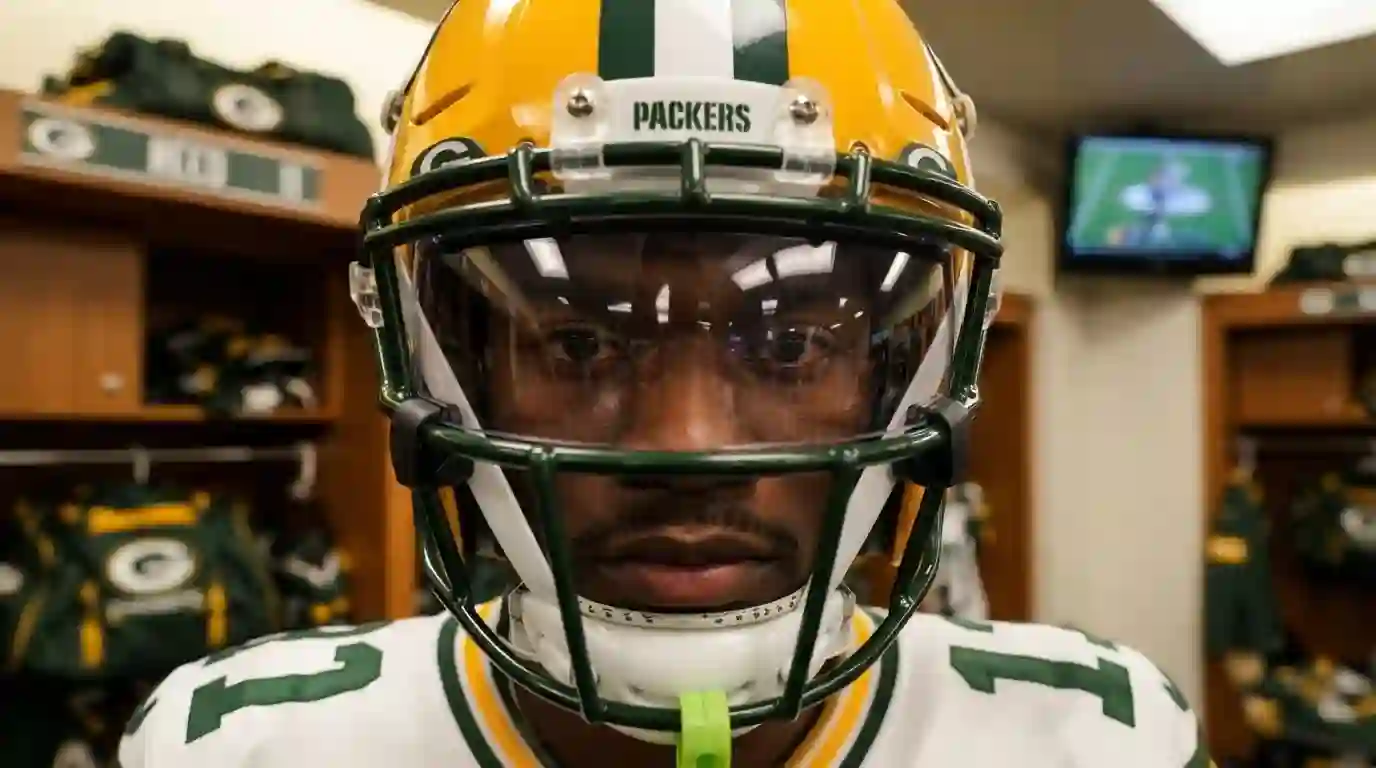
Jayden Reed Stats, Bio, and Game Log: 3 Catches and a Touchdown Power Packers Past Lions 27-13
Most fantasy managers who drafted Jayden Reed expected a fast start, but Green Bay’s slot receiver was invisible through the opening quarter of Week 1. Detroit had taken away his early-down looks, and the doubt was creeping in. Then Jordan Love found him for a 17-yard touchdown that changed the entire math of the afternoon. Here is the complete Jayden Reed stats breakdown from the Packers’ 27-13 win over the Lions.
Jayden Reed Biography Table
| Attribute | Details |
|---|---|
| Player | Jayden Reed |
| Team | Green Bay Packers |
| Position | Wide Receiver |
| Jersey Number | #11 |
| Height / Weight | 5’11” / 187 lb |
| College | Michigan State |
| Draft | 2023 NFL Draft, Round 2, Pick 50 |
| NFL Debut | September 10, 2023 |
| Birthdate | April 28, 2000 |
| Hometown | Naperville, Illinois |
The Green Bay Packers opened their 2025 campaign with a statement, beating the Detroit Lions 27-13 on Sunday, September 7, 2025, before a crowd of 77,239 at Lambeau Field in Green Bay, Wisconsin. The 4:25 PM ET kickoff was broadcast nationally on CBS, and the Packers never trailed after Tucker Kraft’s opening-drive touchdown. Jordan Love completed 16 of 22 passes for 188 yards and two scores with zero interceptions and zero sacks taken, finishing with a 128.6 passer rating.
The story of the afternoon, though, was written on the other side of the ball. Green Bay’s defense held Detroit’s celebrated backfield tandem of David Montgomery and Jahmyr Gibbs to a combined 44 rushing yards on 20 carries, sacked Jared Goff four times, and forced the game’s only turnover. Jayden Reed caught three passes for 45 yards and a touchdown as part of a balanced receiving day in which seven different Packers caught at least one pass.
Match Overview
| Information | Match Details |
|---|---|
| Event | NFL Regular Season — Week 1 |
| Game | Detroit Lions @ Green Bay Packers |
| Date | Sunday, September 7, 2025 |
| Venue | Lambeau Field, Green Bay, WI |
| Attendance | 77,239 |
| Winner | Green Bay Packers |
| Final Score | Packers 27, Lions 13 |
| Broadcast | CBS |
Core Match Statistics Overview
The box score tells a story of a Lions team that controlled the clock but lost the efficiency battle by a wide margin. Detroit held the ball for 35:25 compared to Green Bay’s 24:35, yet was outscored 27-13 because it could not finish drives.
| Team Metric | Detroit Lions | Green Bay Packers |
|---|---|---|
| Total Yards | 246 | 266 |
| Passing Yards | 225 | 188 |
| Rushing Yards | 46 | 78 |
| Yards Per Play | 4.0 | 5.7 |
| First Downs | 16 | 14 |
| Third-Down Conversions | 5/15 (33%) | 4/10 (40%) |
| Fourth-Down Conversions | 3/4 | 1/1 |
| Red-Zone Touchdowns | 1/4 (25%) | 3/5 (60%) |
| Turnovers | 1 | 0 |
| Sacks Allowed | 4 | 0 |
| Penalties | 7-40 | 4-40 |
| Time of Possession | 35:25 | 24:35 |
Rushing Defense Sets the Tone
The single most lopsided gap in the game was on the ground, where the Packers’ front seven erased one of the NFL’s best rushing attacks.
- Montgomery and Gibbs, who terrorized defenses in 2024, combined for just 44 yards on 20 attempts, a 2.2-yard average.
- Green Bay’s defense registered four sacks and nine quarterback hits, winning the line of scrimmage on both early downs and passing downs.
Third Down and Red Zone Efficiency
Converting drives into points, not just first downs, decided this game.
- Detroit converted 16 first downs to Green Bay’s 14 but scored only 13 points, because its red-zone conversion rate was 25% against Green Bay’s 60%.
- The Lions went 5-for-15 on third down and were forced into field-goal attempts on two long marches that stalled inside the Green Bay 15-yard line.
Turnover Margin and Pass Protection
- The Packers played a clean game with zero giveaways, while Evan Williams intercepted Jared Goff to give Green Bay a plus-1 turnover margin.
- Jordan Love was not sacked once behind a reshaped offensive line, while Goff absorbed four sacks and was hit nine times.
Explosive Plays
- Green Bay produced three completions of 25-plus yards, including Romeo Doubs’ 48-yarder and Jayden Reed’s 26-yard catch, the kind of chunk plays Detroit never found outside of a 32-yarder to Sam LaPorta.
- The Packers averaged 5.7 yards per play to Detroit’s 4.0, a gap that explains how the team with the ball for only 24:35 outscored its opponent by 14 points.
Period-by-Period Analysis
First Quarter
| Period | Lions | Packers |
|---|---|---|
| 1st Quarter | 0 | 10 |
- Tucker Kraft’s 15-yard touchdown catch capped a 12-play, 83-yard opening drive, setting the tempo before Detroit could blink.
- Brandon McManus’ 34-yard field goal pushed the lead to 10-0 with 3:58 left in the quarter.
- Detroit’s opening possessions produced nothing, and its early-down run calls were swallowed at the line of scrimmage.
Second Quarter
| Period | Lions | Packers |
|---|---|---|
| 2nd Quarter | 3 | 7 |
- Detroit’s best drive of the half, a 16-play, 78-yard march, stalled at the Green Bay 12, and Jake Bates kicked a 30-yard field goal to make it 10-3.
- Jayden Reed’s 17-yard touchdown reception answered just 55 seconds later, restoring the 14-point cushion at 17-3.
- The Lions held the ball for long stretches but went to the locker room trailing by two touchdowns despite dominating time of possession.
Third Quarter
| Period | Lions | Packers |
|---|---|---|
| 3rd Quarter | 3 | 0 |
- Bates added a 27-yard field goal on Detroit’s opening drive of the half, trimming the lead to 17-6.
- Green Bay’s offense stalled through the quarter, but the defense stiffened whenever Detroit crossed midfield.
- The quarter ended with the Lions still searching for the end zone, a theme that would define the entire game.
Fourth Quarter
| Period | Lions | Packers |
|---|---|---|
| 4th Quarter | 7 | 10 |
- Josh Jacobs’ 3-yard touchdown run, the finish to an 8-play, 36-yard drive, stretched the lead to 24-6 with 7:57 remaining.
- McManus’ 38-yard field goal made it 27-6, effectively sealing the result with 4:22 to play.
- Isaac TeSlaa’s 13-yard touchdown catch from Goff with 55 seconds left only made the final look respectable, and the Lions’ onside kick attempt failed.
Green Bay Packers Player Statistics
Jordan Love
| Passing | Completions | Attempts | Yards | TD | INT | Sacks | Rating |
|---|---|---|---|---|---|---|---|
| Line | 16 | 22 | 188 | 2 | 0 | 0 | 128.6 |
Love was surgical rather than spectacular, spreading 16 completions among ten different receivers and taking zero sacks. His 128.6 passer rating and 92.5 QBR reflect a quarterback who threw on schedule and avoided the negative plays that haunted Goff on the other sideline.
Josh Jacobs
| Rushing | Carries | Yards | Avg | TD | Long |
|---|---|---|---|---|---|
| Line | 19 | 66 | 3.5 | 1 | 15 |
Jacobs grinded out 66 yards on 19 carries, the only back in the game who consistently moved the chains on the ground. His fourth-quarter touchdown put the game out of reach and capped a workmanlike debut in Green Bay.
Jayden Reed
| Receiving | Targets | Receptions | Yards | Avg | TD | Long |
|---|---|---|---|---|---|---|
| Line | 5 | 3 | 45 | 15.0 | 1 | 26 |
Reed’s final line was modest, but the Jayden Reed touchdown came at the game’s hinge moment, a 17-yard strike that answered Detroit’s field goal and made it 17-3 late in the second quarter. His 26-yard catch showed the slot burst that makes him such a dangerous Packers wide receiver, and his five targets tied Romeo Doubs for the team lead.
Romeo Doubs
| Receiving | Targets | Receptions | Yards | Avg | TD | Long |
|---|---|---|---|---|---|---|
| Line | 4 | 2 | 68 | 34.0 | 0 | 48 |
Doubs was Green Bay’s big-play threat, hauling in a 48-yard bomb that set the tone vertically. His 68 receiving yards led all Packers pass catchers on just two grabs.
On defense, Edgerrin Cooper piled up a game-high 12 tackles, Rashan Gary added 1.5 sacks and three quarterback hits, and Micah Parsons recorded a sack in his Green Bay debut. Evan Williams picked off Goff for the game’s lone interception.
Detroit Lions Player Statistics
Jared Goff
| Passing | Completions | Attempts | Yards | TD | INT | Sacks | Rating |
|---|---|---|---|---|---|---|---|
| Line | 31 | 39 | 225 | 1 | 1 | 4 | 88.6 |
Goff completed a high percentage of passes but lived underneath, averaging just 5.8 yards per attempt against a disciplined Packers secondary. Four sacks and one interception undid the volume, and his 48.2 QBR told the story of a passer who rarely threatened the defense.
Sam LaPorta
| Receiving | Targets | Receptions | Yards | Avg | TD | Long |
|---|---|---|---|---|---|---|
| Line | 9 | 6 | 79 | 13.2 | 0 | 32 |
LaPorta was Detroit’s most reliable chain-mover, leading all receivers in the game with 79 yards on six catches. He was the safety valve Goff kept finding when the downfield options were smothered.
Amon-Ra St. Brown
| Receiving | Targets | Receptions | Yards | Avg | TD | Long |
|---|---|---|---|---|---|---|
| Line | 6 | 4 | 45 | 11.3 | 0 | 19 |
St. Brown was held to 45 yards on four catches, a quiet afternoon by his standards. Green Bay’s coverage bracketed him over the middle and forced Goff to look elsewhere on the plays that mattered most.
Jahmyr Gibbs
| All-Purpose | Rushing | Rushing Yards | Receptions | Receiving Yards | Total Yards |
|---|---|---|---|---|---|
| Line | 9 | 19 | 10 | 31 | 50 |
Gibbs touched the ball 19 times but managed only 50 total yards, the clearest sign of how thoroughly Green Bay won the line of scrimmage. Ten of his catches went for 31 yards, nearly all of it underneath.
Statistical Leaders Summary
| Category | Green Bay Packers | Detroit Lions |
|---|---|---|
| Leading Scorer | Brandon McManus — 12 pts (3 FG, 3 PAT) | Jake Bates — 7 pts (2 FG, 1 PAT) |
| Second Leading Scorer | Jayden Reed — 6 pts (1 TD) | Isaac TeSlaa — 6 pts (1 TD) |
| Top Rusher | Josh Jacobs — 19 carries, 66 yds, 1 TD | David Montgomery — 11 carries, 25 yds |
| Top Receiver | Romeo Doubs — 68 yds (2 rec) | Sam LaPorta — 79 yds (6 rec) |
| Top Playmaker | Jordan Love — 188 yds, 2 TD, 0 INT | Jared Goff — 225 yds, 1 TD, 1 INT |
| Top Defender | Edgerrin Cooper — 12 tackles | Jack Campbell — 10 tackles |
Why the Packers Won
Balanced Offensive Production
Green Bay won without a single 100-yard skill player, a sign of how evenly the load was spread.
| Distribution | Packers |
|---|---|
| Players with a catch | 10 |
| Players with a touchdown | 3 (Kraft, Reed, Jacobs) |
| Receivers with 25-plus-yard catch | 3 (Doubs, Reed, Wicks) |
Ten different Packers caught a pass, and three different players found the end zone. That balance kept Detroit’s defense guessing and prevented it from selling out against any one matchup.
Red Zone Execution
| Red-Zone Metric | Packers | Lions |
|---|---|---|
| Red-Zone Trips | 5 | 4 |
| Touchdowns | 3 | 1 |
| Conversion Rate | 60% | 25% |
The Packers turned three of five red-zone trips into touchdowns, while Detroit managed one in four. In a division game decided by 14 points, that gap was the entire margin.
A Front Seven That Owned the Line
| Pass-Rush Metric | Packers Defense |
|---|---|
| Sacks | 4 |
| Quarterback Hits | 9 |
| Tackles For Loss | 9 |
| Rushing Yards Allowed | 46 |
Four sacks and nine quarterback hits kept Goff uncomfortable all afternoon, and the run defense held Detroit to 2.1 yards per carry. When an offense cannot run and its quarterback is under duress, long drives become survival drills.
Turnover-Free Football
| Turnover Metric | Packers | Lions |
|---|---|---|
| Giveaways | 0 | 1 |
| Turnover Margin | +1 | -1 |
Green Bay protected the football and took it away once, a combination that let the Packers play with a lead from the opening drive to the final whistle.
Why the Lions Lost
Volume Without Efficiency
| Metric | Lions |
|---|---|
| Pass Attempts | 39 |
| Yards Per Attempt | 5.8 |
| First Downs | 16 |
| Points Scored | 13 |
Detroit ran 61 plays to Green Bay’s 47 and converted 16 first downs, yet scored 13 points. That is the definition of empty possession, and it came from a passing game that stayed short of the sticks for most of the day.
The Run Game Never Got Going
Detroit’s identity is built on Montgomery and Gibbs, and Green Bay erased it.
- The two backs combined for 44 yards on 20 carries, forcing Goff to throw 39 times against a defense that could then pin its ears back.
- When the run game disappears, play-action loses its teeth, and Detroit’s downfield passing never recovered.
Third-Down Shortfalls
- The Lions converted just 5 of 15 third downs and settled for two short field goals on drives that reached scoring range.
- Twice they crossed into Green Bay territory and came away with three points instead of seven, the difference between staying in the game and chasing it.
Historical Context and Advanced Insights
Season Series Breakdown
The Packers and Lions have traded punches in the NFC North over the past three seasons.
| Date | Matchup | Result |
|---|---|---|
| Sep 28, 2023 | Lions @ Packers | Lions 34, Packers 20 |
| Nov 23, 2023 | Packers @ Lions | Packers 29, Lions 22 |
| Nov 3, 2024 | Lions @ Packers | Lions 24, Packers 14 |
| Dec 5, 2024 | Packers @ Lions | Lions 34, Packers 31 |
| Sep 7, 2025 | Lions @ Packers | Packers 27, Lions 13 |
| Nov 27, 2025 | Packers @ Lions | Packers 31, Lions 24 |
After Detroit swept the 2024 season series, Green Bay flipped the script in 2025, winning both meetings and re-establishing Lambeau Field as a place where the Lions’ offensive machine sputters.
Advanced Statistical Insights
The expected points data from this game is unusually stark. Green Bay finished with plus-14.0 total EPA while Detroit posted minus-14.0, one of the widest single-game gaps of Week 1.
The quarterback split tells the story of two very different approaches. Jordan Love’s passing game added 13.0 expected points, powered by throws downfield on early downs. Jared Goff’s passing added just 2.9 EPA because nearly everything came underneath.
The real wreckage was in the run game. Detroit’s rushing attack finished at minus-6.8 EPA, one of the worst single-game rushing marks any team produced all season. When your running game is that far underwater, play-action, third-and-short, and red-zone football all collapse with it.
Efficiency per play reinforces the same point. Green Bay gained 5.7 yards per play to Detroit’s 4.0, and Love averaged 8.5 yards per attempt to Goff’s 5.8. The Lions tried to win with volume, holding the ball for nearly 36 minutes, but the Packers won with explosiveness in half that time.
Game Implications and Key Lessons
What This Means for Green Bay
- The defense, with Micah Parsons now rushing the passer, has the ceiling of a top-five unit if the front seven keeps producing four sacks and nine hits per game.
- Love’s zero-sack, two-touchdown opener behind a rebuilt line suggests the passing game can operate on schedule, which keeps play-action alive for Jacobs.
- A Week 1 division win plus a later sweep of Detroit gives Green Bay the tiebreaker edge that decides NFC North races.
What This Means for Detroit
- The run game has to be fixed, because 46 rushing yards puts too much pressure on Goff to be perfect from the pocket.
- Red-zone efficiency of 25% will lose close games, and the Lions left points on the field on multiple trips inside the Green Bay 20.
- Detroit needs more downfield intent from its passing game; a 5.8-yard average per attempt is not a winning formula against good defenses.
Key Lessons
- Efficiency beats possession time: the team with the ball for 24:35 outscored the team with it for 35:25.
- Red-zone conversion is the highest-value skill in football; 60% against 25% was the game.
- Slot receivers who win inside create cheap touchdowns, exactly the kind Jayden Reed delivered.
- Clean pass protection unlocks explosive plays, and zero sacks let Love find Doubs and Reed downfield.
- Turnover margin keeps leads comfortable, and the plus-1 edge let Green Bay play downhill all game.
- A dominant defensive line can erase an elite backfield, which is precisely what happened to Gibbs and Montgomery.
Frequently Asked Questions
Who won the Packers vs Lions Week 1 game?
The Green Bay Packers beat the Detroit Lions 27-13 on September 7, 2025, at Lambeau Field in front of 77,239 fans.
What were Jayden Reed’s stats against the Lions?
Jayden Reed caught 3 of 5 targets for 45 yards and a touchdown, with a long reception of 26 yards, in the Packers’ Week 1 win.
Did Jayden Reed score a touchdown in Week 1?
Yes. Reed scored on a 17-yard pass from Jordan Love late in the second quarter, extending Green Bay’s lead to 17-3.
How many fantasy points did Jayden Reed score in Week 1?
Reed finished with 13.5 PPR fantasy points on his 3 catches, 45 yards, and a touchdown, a strong return for anyone who drafted the Packers wide receiver as a WR2 or flex.
How many receiving yards did Jayden Reed have in the game?
Reed recorded 45 receiving yards on three receptions, with his longest catch going for 26 yards.
What is Jayden Reed’s role in the Green Bay offense?
Reed operates primarily from the slot, where his quickness creates mismatches on intermediate routes. His Week 1 usage, with five targets and a red-zone look, confirms he is a core piece of the Packers wide receiver rotation behind the vertical threat of Romeo Doubs.
The Bottom Line
Green Bay’s 27-13 win over Detroit was a masterclass in efficiency over volume. The Lions ran more plays, held the ball longer, and completed more passes, yet scored fewer points because the Packers won the plays that actually decide games: third downs in scoring range, red-zone trips, pass protection, and the turnover battle. Jayden Reed’s touchdown was the turning point, but the broader lesson is that balanced, efficient, turnover-free football beats raw possession and attempt counts every time. For fantasy managers and Packers fans alike, the Jayden Reed stats from Week 1 marked the kind of efficient, high-value performance that makes him a weekly starter when healthy.