
LSU Football: The Definitive Guide to the Tigers’ Legacy, Championships, and Future
Missing out on LSU Football history means missing one of college football’s most electrifying stories. Fans everywhere search for accurate stats, championship details, and player legacies but find scattered, outdated information. This guide fixes that problem. You get every essential fact about LSU Football in one place — from national titles to Tiger Stadium traditions — so you never second-guess the details again.
What Makes LSU Football One of College Football’s Greatest Programs?
LSU Football stands among the most decorated programs in the sport’s history. The Tigers compete in the Southeastern Conference (SEC), widely recognized as the toughest division in college football. Since the program’s founding in 1893, the purple and gold have built a legacy that few schools can match.
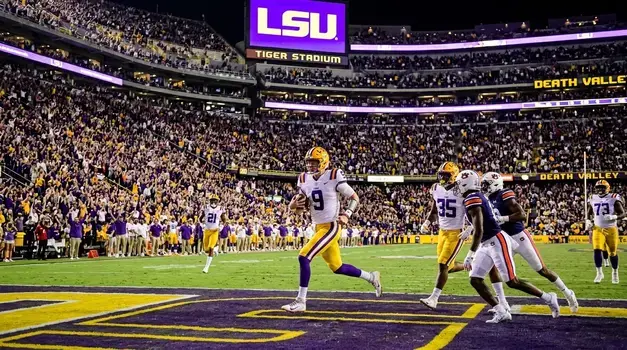
Baton Rouge transforms into a sea of purple every fall. Over 100,000 fans pack Tiger Stadium on game days, creating an atmosphere that rattles opposing quarterbacks and energizes the home squad. That energy fuels a program that has produced Heisman Trophy winners, NFL superstars, and unforgettable championship runs.
The Tigers hold a winning record against nearly every opponent they face. Their all-time win total exceeds 800 victories, placing them firmly among the top 15 programs in NCAA history (Source: NCAA Official Records).
How Many National Championships Has LSU Football Won?
LSU Football captured four claimed national championships, each one marking a defining era for the program. The Tigers earned titles in 1958, 2003, 2007, and 2019. Every championship season carried its own unique storyline and roster of legendary talent.
The 2019 season stands as arguably the greatest single year in college football history. Quarterback Joe Burrow threw for 5,671 yards and 60 touchdowns, leading the Tigers to a perfect 15-0 record. That squad dismantled Clemson 42-25 in the national title game, silencing every doubter.
| Year | Head Coach | Record | Championship Game Result | Key Player |
| 1958 | Paul Dietzel | 11-0 | Defeated Clemson 7-0 (Sugar Bowl) | Billy Cannon |
| 2003 | Nick Saban | 13-1 | Defeated Oklahoma 21-14 (BCS) | Matt Mauck |
| 2007 | Les Miles | 12-2 | Defeated Ohio State 38-24 (BCS) | Matt Flynn |
| 2019 | Ed Orgeron | 15-0 | Defeated Clemson 42-25 (CFP) | Joe Burrow |
The 1958 squad earned the nickname “The Chinese Bandits” for their ferocious defensive unit. Paul Dietzel’s three-platoon system revolutionized how coaches managed player fatigue, and the strategy paid off with an undefeated season.
Who Are the Most Legendary LSU Football Players in History?
The Tigers have sent dozens of players to the NFL, but a select group transcended the college game entirely. These athletes redefined their positions and left permanent marks on the sport.
Joe Burrow (2018–2019) won the Heisman Trophy by the largest margin in history at the time. His 60-touchdown season shattered records and propelled him to the number one overall NFL Draft pick.
Billy Cannon (1957–1959) remains the only LSU player to win the Heisman Trophy before Burrow. His Halloween night punt return against Ole Miss in 1959 is still the most famous play in school history.
Odell Beckham Jr. (2011–2013) dazzled fans with acrobatic catches and explosive speed. He became an instant NFL star after the New York Giants drafted him in the first round.
Leonard Fournette (2014–2016) rushed for 3,830 career yards and averaged 6.5 yards per carry. Defenses stacked the box against him every single game, and he still dominated.
| Player | Years | Position | Major Honor | NFL Draft Pick |
| Joe Burrow | 2018–2019 | QB | Heisman Trophy | No. 1 Overall (2020) |
| Billy Cannon | 1957–1959 | RB | Heisman Trophy | No. 1 Overall (1960) |
| Odell Beckham Jr. | 2011–2013 | WR | Biletnikoff Finalist | No. 12 Overall (2014) |
| Leonard Fournette | 2014–2016 | RB | Doak Walker Finalist | No. 4 Overall (2017) |
| Tyrann Mathieu | 2010–2011 | DB | Heisman Finalist | Round 3 (2013) |
| Glenn Dorsey | 2004–2007 | DT | Outland Trophy | No. 5 Overall (2008) |
Tyrann Mathieu, known as “The Honey Badger,” changed games with forced fumbles and punt returns despite his smaller frame. His 2011 season ranks among the most disruptive defensive campaigns ever recorded.
What Is Tiger Stadium and Why Do Fans Call It “Death Valley”?
Tiger Stadium sits on the LSU campus in Baton Rouge and holds 102,321 fans, making it one of the largest on-campus stadiums in the country. The venue earned the nickname “Death Valley” because visiting teams consistently struggle to communicate and execute plays amid the deafening noise.
The stadium opened in 1924 with a modest 12,000 seats. Multiple expansions over the decades transformed it into the massive structure fans see today. The south end zone upper deck, completed in 2014, pushed capacity past the 100,000 mark.
| Stadium Fact | Detail |
| Official Name | Tiger Stadium |
| Nickname | Death Valley |
| Location | Baton Rouge, Louisiana |
| Current Capacity | 102,321 |
| Year Opened | 1924 |
| Playing Surface | Natural Grass |
| Largest Attendance | 103,273 (2019 vs. Alabama) |
| Night Game Record | Historically dominant under the lights |
Night games at Tiger Stadium carry a special mystique. The Tigers win a significantly higher percentage of games played after dark, a trend that visiting coaches openly dread. The combination of humidity, crowd noise, and stadium lighting creates conditions that favor the home team in measurable ways.
How Does LSU Football Recruiting Compare to Other SEC Programs?
LSU Football consistently lands top-five recruiting classes on the national stage. The state of Louisiana produces extraordinary high school talent per capita, and the Tigers lock down their home territory better than almost any program in the country.
Recruiting battles against Alabama, Texas A&M, and Georgia define the SEC landscape every signing period. LSU holds a geographic advantage with access to talent-rich cities like New Orleans, Baton Rouge, and Shreveport. The pipeline from Louisiana high schools to the Tigers roster remains the strongest in the region.
Brian Kelly elevated recruiting efforts after arriving in 2022. His staff targets elite quarterbacks and defensive linemen with aggressive national outreach while maintaining deep roots in the Bayou State.
- 2023 Recruiting Class: Ranked No. 4 nationally by 247Sports
- 2024 Recruiting Class: Ranked No. 5 nationally
- Five-Star Signees (2020–2024): 12 players
- Top Louisiana Prospects Signed: 85% retention rate
The Tigers also benefit from NIL (Name, Image, Likeness) collectives that help attract transfer portal talent. The “Bayou Bengals” collective ranks among the most active in the SEC, providing competitive deals that keep top players in purple and gold.
What Is the LSU Football All-Time Record Against Rivals?
Rivalry games define the emotional core of college football, and the Tigers carry fierce matchups against several opponents. The annual clash with Alabama stands as the most anticipated game on the schedule each November.
The Tigers also battle Ole Miss for the Magnolia Bowl, a rivalry stretching back to 1894. Texas A&M joined the rivalry mix when the Aggies entered the SEC in 2012, adding another heated contest to the calendar.
| Rival | All-Time Record (W-L-T) | Rivalry Name | Most Memorable Game |
| Alabama | 27-56-5 | First Saturday in November | 2019: LSU 46, Alabama 41 |
| Ole Miss | 64-42-4 | Magnolia Bowl | 1959: Billy Cannon’s punt return |
| Arkansas | 43-23-2 | Battle for the Golden Boot | 2007: Triple-overtime thriller |
| Auburn | 31-24-1 | SEC West Showdown | 2019: LSU 23, Auburn 20 |
| Texas A&M | 36-22-3 | SEC Rivalry | 2018: Seven-overtime classic |
| Florida | 31-33-3 | SEC East Crossover | 2007: LSU 28, Florida 24 |
The 2018 Texas A&M game lasted seven overtimes and ended 74-72 in favor of the Aggies. That contest directly prompted the NCAA to change overtime rules, requiring two-point conversion attempts after the second overtime.
Which Coaches Transformed LSU Football Into a National Powerhouse?
Several head coaches shaped the Tigers into the program fans recognize today. Each brought a distinct philosophy and left lasting infrastructure behind.
Paul Dietzel (1955–1961) introduced the three-platoon system and delivered the 1958 national championship. His innovative approach to player rotation gave LSU a conditioning advantage that opponents could not match.
Nick Saban (2000–2004) rebuilt the program’s culture and recruiting machine before departing for the NFL. His 2003 national championship restored LSU to the sport’s elite tier after a prolonged drought.
Les Miles (2005–2016) won the 2007 national title and embraced an unpredictable, aggressive style that fans adored. His “Mad Hatter” persona became synonymous with bold fourth-down calls and trick plays.
Ed Orgeron (2016–2021) orchestrated the greatest single season in program history. His 2019 squad went 15-0 and featured the most prolific offense college football had ever witnessed.
| Coach | Tenure | Record | National Titles | Signature Achievement |
| Paul Dietzel | 1955–1961 | 46-24-3 | 1 (1958) | Three-platoon system |
| Charles McClendon | 1962–1979 | 137-59-8 | 0 | Longest-tenured coach |
| Nick Saban | 2000–2004 | 48-16 | 1 (2003) | Culture and recruiting overhaul |
| Les Miles | 2005–2016 | 114-34 | 1 (2007) | Aggressive play-calling |
| Ed Orgeron | 2016–2021 | 52-25 | 1 (2019) | Perfect 15-0 season |
| Brian Kelly | 2022–Present | Active | 0 | Modern offensive transition |
Brian Kelly arrived from Notre Dame with a proven track record of building championship-caliber programs. His task involves modernizing the offense while maintaining the physical identity that SEC football demands (Source: LSU Athletics Official).
How Has LSU Football Performed in the College Football Playoff?
The College Football Playoff (CFP) era began in 2014, and the Tigers made their most impactful appearance during the 2019 season. That year, LSU earned the top seed and defeated Oklahoma 63-28 in the Peach Bowl semifinal before beating Clemson in the title game.
The 2023 season saw LSU earn a CFP berth as well, though the Tigers fell short in the quarterfinal round. The expanded 12-team playoff format starting in 2024 gives LSU more pathways to compete for national titles in future seasons.
- 2019 CFP: National Champions (defeated Oklahoma, Clemson)
- 2023 CFP: Quarterfinal appearance
- CFP Appearances Total: 2
- CFP Game Record: 2-1
The expanded playoff format benefits deep, talented rosters like the Tigers typically field. More games mean more opportunities for high-powered offenses to accumulate momentum and showcase their skill against top competition.
What Are the Key LSU Football Traditions Every Fan Should Know?
Traditions bind the LSU community together and create experiences that extend far beyond the scoreboard. Every game day in Baton Rouge follows a rhythm that generations of fans have perfected.
Mike the Tiger serves as the live mascot and lives in a $3.7 million habitat adjacent to Tiger Stadium. The tradition dates back to 1936, and the current Mike (Mike VII) roams his enclosure before every home game.
“Callin’ Baton Rouge” plays after every Tigers victory. The crowd sings along to the Garth Brooks classic, creating one of the most recognizable postgame celebrations in all of sports.
The Golden Band from Tigerland performs the pregame show, including the iconic “Salute to LSU” formation. The band’s halftime performances regularly go viral for their precision and creativity.
- Tailgating: Fans arrive 6+ hours early to set up elaborate spreads near the stadium
- Victory Hill: Players walk through a tunnel of fans before entering Tiger Stadium
- First Down Chant: The crowd roars “Geaux Tigers!” after every first down
- Purple and Gold Attire: Fans wear team colors exclusively on game days
How Does LSU Football’s Offense and Defense Stack Up in the SEC?
The SEC produces NFL-ready talent on both sides of the ball, and LSU consistently ranks among the conference’s best units. The 2019 offense set the standard with 726 total points, the most in a single FBS season at the time.
Defensively, the Tigers rely on speed and athleticism along the defensive line. The program’s ability to recruit elite edge rushers and cornerbacks keeps opposing passing attacks under constant pressure throughout conference play.
| Statistical Category | 2023 Season Rank (SEC) | National Rank |
| Points Per Game | 4th | 15th |
| Passing Yards Per Game | 3rd | 11th |
| Rushing Yards Per Game | 8th | 42nd |
| Sacks | 5th | 22nd |
| Turnovers Forced | 3rd | 14th |
| Red Zone Defense | 6th | 28th |
The offensive identity continues evolving under Brian Kelly’s system. The Tigers emphasize quick passing concepts, run-pass options, and vertical shots downfield that exploit the speed of their wide receiver corps.
What Does the Future Hold for LSU Football Under Brian Kelly?
Brian Kelly inherited a talented roster and immediately pushed the program toward a more balanced offensive attack. His first two seasons produced 20 combined wins, signaling a rapid return to national relevance.
The transfer portal and NIL landscape reshaped how programs build rosters, and Kelly adapted quickly. His staff identifies specific positional needs and targets experienced players who can contribute immediately rather than waiting for development cycles.
The expanded 12-team College Football Playoff gives LSU a clearer path to championship contention. With elite recruiting classes arriving each year and a modernized offensive scheme, the Tigers position themselves to compete for titles throughout the remainder of the decade.
Where Can Fans Watch LSU Football Games Live?
LSU games air across several major networks depending on the matchup and scheduling agreements. The SEC’s media deal with ESPN and ABC ensures that most conference games receive national television coverage.
- ESPN / ABC: Primary broadcasts for SEC conference games
- CBS: Select SEC games through existing agreements
- SEC Network: Non-conference and early-season matchups
- ESPN+: Streaming for select games and replays
- LSU Sports Radio Network: Full audio coverage for every game
Fans outside the Baton Rouge area can also attend watch parties hosted by LSU alumni chapters in major cities across the United States. These gatherings replicate the Tiger Stadium atmosphere and keep the community connected regardless of geography.
Take the Next Step and Join the Tiger Nation
LSU Football carries a legacy built on championship seasons, legendary players, and an unmatched game-day atmosphere in Baton Rouge. From the roar of Death Valley to the brilliance of Joe Burrow’s record-breaking campaign, the Tigers continue writing chapters that captivate fans across the country.
Whether you plan your first trip to Tiger Stadium or simply want to stay informed about recruiting and playoff races, the purple and gold community welcomes you. Follow the Tigers this season, share your favorite memories, and experience the passion that makes LSU Football one of the greatest programs in American sports.