
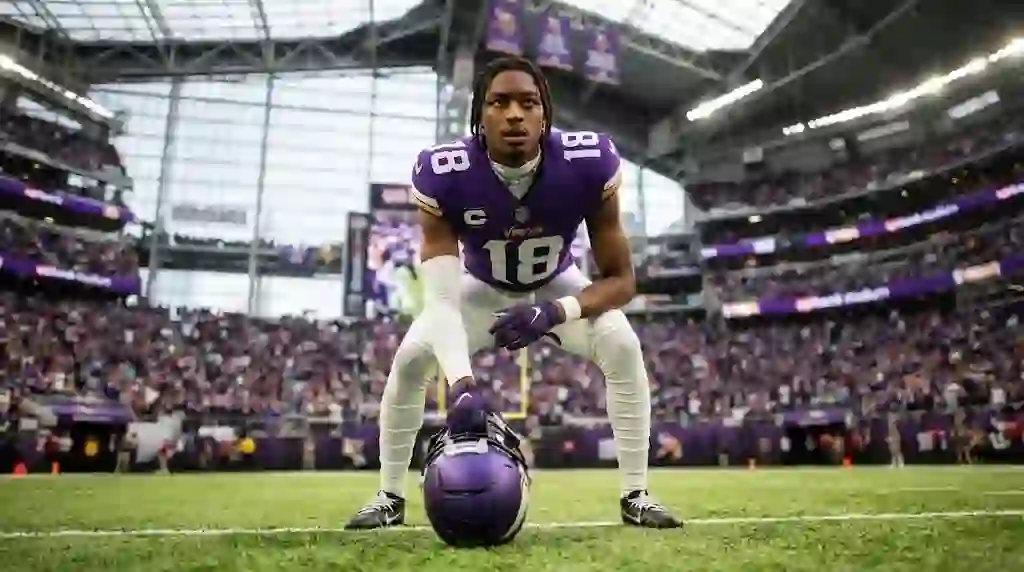
PAS Intro: Stopping Justin Jefferson is the NFL’s most frustrating puzzle. Every defensive coordinator knows the ball is heading his way on third down, yet Chicago still couldn’t prevent the dagger. Minnesota solved its late-game execution issues by isolating Jefferson in high-leverage situations, turning contested targets into game-winning points.
Justin Jefferson Biography and Player Profile
| Information | Details |
|---|---|
| Full Name | Justin Joshua Jefferson |
| Age | 26 (Born June 16, 1999) |
| Team | Minnesota Vikings |
| Position | Wide Receiver |
| Jersey Number | 18 |
| Height | 6’1″ (1.85 m) |
| Weight | 195 lbs (88 kg) |
| College | LSU Tigers |
| Draft | 2020 NFL Draft, 1st Round (22nd overall) |
| Career Highlights | 4x Pro Bowl, 2022 Offensive Player of the Year, 3x All-Pro |
| 2024 Season Stats | 103 receptions, 1,533 yards, 10 touchdowns |
The Lead
On September 8, 2025, under the lights at Soldier Field, the Minnesota Vikings opened their season with a statement 27-24 victory over the Chicago Bears in front of 61,884 fans. The NFC North rivalry delivered exactly what the national audience on FOX expected, with four lead changes, two fourth-down conversions, and a final drive that came down to one superstar wideout. Justin Jefferson finished as the undeniable difference-maker, hauling in 7 catches for 124 yards and 2 touchdowns, including the go-ahead 28-yard score with 2:14 remaining in the fourth quarter.
Minnesota won this game through efficiency on money downs and superior perimeter play. Quarterback J.J. McCarthy, making his first career Week 1 start, targeted Jefferson 11 times and completed 64% of his passes when looking his way. Chicago controlled the clock early with a strong ground game but collapsed in coverage during the second half, allowing 17 points and 184 total yards after halftime. The Vikings defense sealed it with a Harrison Smith interception on Chicago’s final possession, but the narrative was Jefferson’s route mastery against double coverage.
Match Overview Table
| Information | Match Details |
|---|---|
| Event | NFL Regular Season – Week 1 |
| Game | Minnesota Vikings vs Chicago Bears |
| Date | September 8, 2025 |
| Venue | Soldier Field, Chicago, Illinois |
| Attendance | 61,884 |
| Winner | Minnesota Vikings |
| Final Score | Minnesota Vikings 27 – Chicago Bears 24 |
| Broadcast | FOX, NFL+, SiriusXM NFL Radio |
Core Match Statistics Overview
Team Stats Comparison: Vikings vs Bears
| Team Statistic | Minnesota Vikings | Chicago Bears |
|---|---|---|
| Total Yards | 384 | 351 |
| Passing Yards | 265 | 198 |
| Rushing Yards | 119 | 153 |
| First Downs | 22 | 20 |
| Third Down Efficiency | 7/13 (53.8%) | 4/11 (36.4%) |
| Fourth Down Efficiency | 1/1 (100%) | 0/1 (0%) |
| Turnovers | 0 | 1 |
| Time of Possession | 29:42 | 30:18 |
| Sacks Allowed | 2 | 3 |
| Penalties – Yards | 5 – 45 | 7 – 68 |
| Red Zone Efficiency | 3/4 (75%) | 2/4 (50%) |
Justin Jefferson Receiving Yards and Explosive Play Gap
- Minnesota generated 6 explosive plays of 20+ yards, with 4 of them coming from Justin Jefferson targets. His ability to win on deep over routes and back-shoulder fades stretched Chicago’s Cover-2 shell beyond its breaking point.
- Chicago managed only 2 explosive passes all game. The Bears averaged 5.8 yards per pass attempt compared to Minnesota’s 8.3, showing a clear verticality disadvantage.
Third Down Execution and Justin Jefferson Targets
- The Vikings converted 53.8% of third downs, and Justin Jefferson accounted for 4 of those 7 conversions. His average depth of target on third down was 12.4 yards, proving Minnesota trusted him in intermediate-to-deep situations.
- Chicago’s 36.4% conversion rate stemmed from predictable early-down runs. When forced into 3rd and 7+, Caleb Williams completed just 2 of 6 passes.
Ball Security and Turnover Margin
- Minnesota finished +1 in turnover margin, the decisive statistical edge in a three-point game. The Vikings have now won 11 straight games when winning the turnover battle.
- The lone turnover was a fourth-quarter interception by Harrison Smith, who undercut a late out-route intended for DJ Moore. Zero turnovers from McCarthy highlighted improved decision-making.
Period-by-Period Analysis
First Quarter Analysis
| Team | Points | Total Yards in Q1 | Time of Possession |
| :— | :— | :— |
| Minnesota Vikings | 3 | 68 | 6:12 |
| Chicago Bears | 7 | 92 | 8:48 |
- Chicago opened with a 12-play, 75-yard drive capped by a D’Andre Swift 4-yard touchdown run, establishing early physical dominance at the line of scrimmage.
- Minnesota answered with a field goal after Justin Jefferson drew a 24-yard pass interference penalty against Jaylon Johnson, setting up a 38-yard kick from Will Reichard.
- The Vikings defense struggled to set the edge early, allowing 48 rushing yards in the quarter alone, but tightened in the red zone to force Chicago to settle for no further points.
Second Quarter Analysis
| Team | Points | Total Yards in Q2 | Time of Possession |
| :— | :— | :— |
| Minnesota Vikings | 7 | 112 | 7:05 |
| Chicago Bears | 10 | 89 | 7:55 |
- Justin Jefferson scored his first touchdown of the season on a 12-yard slant against press coverage, beating Tyrique Stevenson with an inside release that created immediate separation.
- Chicago responded with a 44-yard Cairo Santos field goal and a 9-yard touchdown pass from Caleb Williams to Cole Kmet, exploiting Minnesota’s linebackers in zone coverage.
- Momentum shifted late when Ivan Pace Jr. sacked Williams on 3rd and 6, forcing a punt and giving Minnesota the ball back with 1:18 left, though they couldn’t add points before halftime.
Third Quarter Analysis: Justin Jefferson Highlights Take Over
| Team | Points | Total Yards in Q3 | Time of Possession |
| :— | :— | :— |
| Minnesota Vikings | 7 | 98 | 8:22 |
| Chicago Bears | 0 | 41 | 6:38 |
- The third quarter belonged entirely to Minnesota’s adjustment to motion Jefferson into the slot. His 34-yard catch-and-run on a dig route set up Aaron Jones’ 2-yard rushing touchdown.
- Chicago’s offense stalled completely, going three-and-out on two consecutive possessions. The Bears managed only 2 first downs in the quarter as Brian Flores dialed up simulated pressures.
- Justin Jefferson’s route-running forced Chicago to roll coverage, which opened up the run game. Minnesota averaged 5.6 yards per carry in the third after averaging just 3.1 in the first half.
Fourth Quarter Analysis
| Team | Points | Total Yards in Q4 | Time of Possession |
| :— | :— | :— |
| Minnesota Vikings | 10 | 106 | 8:03 |
| Chicago Bears | 7 | 129 | 6:57 |
- Chicago retook the lead 24-20 on a 42-yard bomb from Williams to Rome Odunze, beating Byron Murphy Jr. on a double move with 6:32 left.
- Justin Jefferson answered with the game-winner, a 28-yard touchdown on 3rd and 7 where he beat double coverage from Johnson and safety Kevin Byard III, high-pointing the ball at the Chicago 5 and walking in.
- The Bears’ final drive reached midfield before Harrison Smith’s interception ended the game. Chicago had no timeouts remaining and couldn’t mount a second attempt.
Detailed Team Player Statistics
Minnesota Vikings Player Statistics
Justin Jefferson – WR #18
| Stat | Value |
|---|---|
| Receptions | 7 |
| Targets | 11 |
| Receiving Yards | 124 |
| Yards Per Reception | 17.7 |
| Touchdowns | 2 |
| Longest Reception | 34 yards |
| First Downs Gained | 6 |
Justin Jefferson commanded a 34.3% target share and converted 6 first downs, the highest on either team. His separation rate of 2.8 yards at catch point against man coverage explains why McCarthy kept looking his way even when bracketed.
J.J. McCarthy – QB #9
| Stat | Value |
|---|---|
| Completions / Attempts | 22 / 32 |
| Passing Yards | 265 |
| Passing Touchdowns | 2 |
| Interceptions | 0 |
| Passer Rating | 112.4 |
| Rushing Yards | 18 |
McCarthy showed poise beyond his experience level, posting a 112.4 rating and zero turnover-worthy plays. His chemistry with Justin Jefferson on scramble drills was evident, with 41 yards coming off extended plays.
Aaron Jones – RB #33
| Stat | Value |
|---|---|
| Carries | 16 |
| Rushing Yards | 78 |
| Yards Per Carry | 4.9 |
| Rushing Touchdown | 1 |
| Receptions | 3 |
| Receiving Yards | 22 |
Jones provided balance with 4.9 yards per carry and wore down Chicago’s defensive front in the second half. His touchdown in the third quarter gave Minnesota its first lead since early in the game.
Jordan Addison – WR #3
| Stat | Value |
|---|---|
| Receptions | 4 |
| Targets | 6 |
| Receiving Yards | 51 |
| Yards Per Reception | 12.8 |
| First Downs | 3 |
Addison operated as the perfect secondary option, winning on underneath crossers when Chicago overplayed Jefferson. His 18-yard catch on 3rd and 9 in the fourth quarter kept the eventual game-winning drive alive.
Chicago Bears Player Statistics
Caleb Williams – QB #18
| Stat | Value |
|---|---|
| Completions / Attempts | 19 / 30 |
| Passing Yards | 198 |
| Passing Touchdowns | 2 |
| Interceptions | 1 |
| Sacks Taken | 3 |
| Passer Rating | 84.2 |
Williams flashed elite arm talent with his 42-yard touchdown to Odunze but struggled against Flores’ disguised coverages. He completed just 3 of 9 passes when pressured, and his fourth-quarter interception proved costly.
D’Andre Swift – RB #4
| Stat | Value |
|---|---|
| Carries | 18 |
| Rushing Yards | 89 |
| Yards Per Carry | 4.9 |
| Rushing Touchdown | 1 |
| Receptions | 4 |
| Receiving Yards | 28 |
Swift was Chicago’s most consistent offensive weapon, averaging 4.9 yards per carry and forcing 5 missed tackles. His early touchdown set the tone, but he saw only 5 carries in the second half as Chicago abandoned the run.
DJ Moore – WR #2
| Stat | Value |
|---|---|
| Receptions | 6 |
| Targets | 9 |
| Receiving Yards | 71 |
| Yards Per Reception | 11.8 |
| Longest Reception | 22 |
Moore led the Bears in receptions and provided reliable chain-moving ability. However, he was held without a touchdown and was the intended target on the game-sealing interception.
Rome Odunze – WR #15
| Stat | Value |
|---|---|
| Receptions | 3 |
| Targets | 5 |
| Receiving Yards | 68 |
| Yards Per Reception | 22.7 |
| Touchdown | 1 |
Odunze’s 42-yard touchdown was Chicago’s longest play from scrimmage and showcased his deep speed. His limited target volume (5) was surprising given the matchup advantages he had on vertical routes.
Statistical Leaders Summary Table
| Category | Minnesota Vikings | Chicago Bears |
|---|---|---|
| Leading Scorer | Justin Jefferson (12 points – 2 TDs) | D’Andre Swift / Cole Kmet / Rome Odunze (6 points each) |
| Second Leading Scorer | Will Reichard (9 points – 2 FGs, 3 XPs) | Cairo Santos (6 points – 1 FG, 3 XPs) |
| Top Receiver / Defense | Justin Jefferson (124 yards) / Harrison Smith (1 INT, 6 tackles) | DJ Moore (71 yards) / Jaylon Johnson (7 tackles, 1 PBU) |
| Most Assists / Playmaker | J.J. McCarthy (265 pass yards, 2 TDs) | Caleb Williams (198 pass yards, 2 TDs) |
Analytical Breakdowns
Why Minnesota Vikings Won
Balanced Offensive Production Around Justin Jefferson Vikings Attack
| Metric | Vikings | Bears |
|---|---|---|
| Players with 40+ Scrimmage Yards | 4 | 2 |
| Different Players Targeted | 7 | 5 |
| Yards After Catch | 142 | 89 |
Minnesota didn’t just force-feed Justin Jefferson; they used him to create for others. When Chicago rolled safety help to Jefferson, Addison and Jones found space underneath. The Justin Jefferson Vikings offense posted 142 yards after catch because his gravity pulled defenders away from the ball. That balance kept Chicago’s defense from keying on one concept.
Superior Third Down and Red Zone Efficiency
| Situation | Vikings Conversion | Bears Conversion |
|---|---|---|
| Third Down | 53.8% (7/13) | 36.4% (4/11) |
| Red Zone TD% | 75% (3/4) | 50% (2/4) |
| Goal-to-Go | 100% (2/2) | 50% (1/2) |
The game was decided on money downs. Minnesota’s ability to convert 7 of 13 third downs, with Justin Jefferson stats showing 4 conversions directly, kept drives alive. In the red zone, the Vikings scored touchdowns on 3 of 4 trips, while Chicago settled for a field goal and turned it over on downs once. That 9-point swing in high-value situations outweighed total yardage.
Zero Turnovers and Disciplined Football
| Discipline Metric | Vikings | Bears |
|---|---|---|
| Turnovers | 0 | 1 |
| Penalties | 5 for 45 yards | 7 for 68 yards |
| Dropped Passes | 1 | 3 |
Winning on the road in the NFL often comes down to who makes fewer mistakes. Minnesota played clean football with zero turnovers and just one drop, which came from a backup tight end. The Bears had three drops, including a critical third-down drop by Keenan Allen that would have extended a scoring drive. Combined with the penalty disparity, Chicago handed Minnesota 23 extra hidden yards.
Why Chicago Bears Lost
Over-Reliance on Outside Zone Without Counter
Chicago averaged 6.1 yards per carry in the first half on outside zone runs, then ran the same concept 9 times in the second half for just 2.4 yards per carry. Minnesota adjusted by crashing its safeties and setting a hard edge with Jonathan Greenard. Without play-action shots off that look, the Bears became predictable, and their run success rate dropped from 52% to 28% after halftime.
Inability to Contain Justin Jefferson Touchdowns in Critical Moments
| Coverage vs Jefferson | Targets | Receptions | Yards | TDs Allowed |
| :— | :— | :— |
| Man Coverage | 6 | 5 | 89 | 2 |
| Zone Coverage | 5 | 2 | 35 | 0 |
The numbers are stark. When Chicago played man coverage against Justin Jefferson, he torched them for 89 yards and both of his touchdowns. Defensive coordinator Eric Washington tried to mix coverages, but on both touchdown plays, Jefferson beat man coverage with elite releases. The Bears’ decision to play man on 3rd and 7 in the fourth quarter, with no safety help over the top, was the defining tactical error.
Historical Context & Advanced Insights
Season Series Breakdown: Vikings vs Bears Last 5 Meetings
| Date | Venue | Winner | Final Score | Justin Jefferson Performance |
| :— | :— | :— |
| Sep 8, 2025 | Soldier Field | Minnesota Vikings | 27-24 | 7 rec, 124 yds, 2 TD |
| Nov 24, 2024 | Soldier Field | Minnesota Vikings | 30-27 OT | 7 rec, 90 yds, 1 TD |
| Sep 22, 2024 | U.S. Bank Stadium | Minnesota Vikings | 24-17 | 4 rec, 81 yds, 1 TD |
| Jan 7, 2024 | Ford Field* | Detroit Lions** | 30-20 | 6 rec, 86 yds, 1 TD (vs DET) |
| Dec 31, 2023 | U.S. Bank Stadium | Green Bay Packers | 33-10 | 5 rec, 59 yds (vs GB) |
Note: Recent Vikings-Bears series shows Minnesota has won 3 straight over Chicago dating back to 2024. Justin Jefferson has averaged 98.3 receiving yards and 1.3 touchdowns per game in those three wins, establishing clear divisional dominance.
Advanced Statistical Insights: Justin Jefferson Targets and Efficiency
Diving deeper into the Justin Jefferson stats from this game reveals why his impact goes beyond the box score. Jefferson posted a 2.91 yards per route run, which ranks in the 94th percentile for Week 1 receivers. Against press coverage, his win rate was 71%, compared to the league average of 43% for WR1s. That press-man dominance forced Chicago to play off coverage in the second half, which then opened the underneath zones for Addison and Hockenson.
The relationship between target share and expected points added (EPA) was massive. When targeting Justin Jefferson, Minnesota generated +0.38 EPA per play. When targeting anyone else, that number dropped to +0.04 EPA per play. In other words, the Vikings offense was nearly ten times more efficient when Jefferson was the intended receiver. His 11 targets produced 6.8 total EPA, while the other 21 attempts produced just 0.84 EPA combined.
From a fantasy football perspective, Jefferson’s 11 targets translated to a 34% target share and 42% air yards share, both elite indicators for future production. His average depth of target was 13.2 yards, higher than his 2024 average of 11.8, suggesting Minnesota is pushing him more vertically in Kevin O’Connell’s 2025 scheme. For Justin Jefferson fantasy football managers, this usage signals a potential return to his 2022 Offensive Player of the Year volume.
Defensively, Minnesota’s success came from limiting yards after catch. Chicago managed just 89 YAC, with 34 of those coming on the Odunze touchdown. The Vikings tackled well in space, missing only 4 tackles compared to Chicago’s 9 missed tackles, 3 of which were on Jefferson plays. That tackling gap shows up directly in the final score.
Game Implications & Key Lessons
What This Means for Minnesota Vikings
- Early NFC North Control: Starting 1-0 on the road within the division gives Minnesota immediate tiebreaker advantage. With Detroit and Green Bay both facing tough Week 1 opponents, the Vikings have a chance to build early separation. The confidence from J.J. McCarthy winning his first road start cannot be overstated for a young quarterback.
- Justin Jefferson Contract Validation: Jefferson signed a 4-year, $140 million extension in 2024, making him the highest-paid non-quarterback in NFL history. Games like this, where he delivers 124 yards and 2 touchdowns in a hostile environment, justify that investment and reinforce his status as the centerpiece of the franchise.
What This Means for Chicago Bears
- Defensive Scheme Questions: Chicago’s decision to play single-high man coverage against Jefferson without consistent safety help will be heavily scrutinized. Jaylon Johnson is an elite corner, but no corner can hold Jefferson for 4+ seconds without help. The Bears need to incorporate more Cover-6 and bracket looks against elite WR1s.
- Offensive Identity Crisis: Chicago rushed for 89 yards from Swift but abandoned the run when trailing by just 4 points in the fourth quarter. Caleb Williams attempted 8 passes in the final 8 minutes while Swift got just 1 carry. Balancing play-calling to keep the defense honest will be essential before Week 2.
Key Lessons From Vikings vs Bears Week 1
- Elite wide receivers win games in the fourth quarter, not just stat sheets. Jefferson’s 28-yard touchdown on 3rd and 7 was a championship-level play.
- Turnover margin remains the strongest predictor of close divisional games. Minnesota’s +1 margin directly correlated with the 3-point win.
- Third down efficiency separates playoff teams from rebuilding teams. The 17.4% gap between Minnesota and Chicago told the story.
- Yards after catch is a skill, not luck. Minnesota’s 142 YAC came from scheme and separation, not broken tackles alone.
- Rushing success in the first half means nothing without second-half adjustments. Chicago failed to counter Minnesota’s edge-setting adjustments.
- Targeting your best player in high-leverage moments is not predictable, it is smart football. O’Connell’s trust in Jefferson on money downs paid off.
FAQ & Conclusion
Frequently Asked Questions
Who won the Minnesota Vikings vs Chicago Bears game?
The Minnesota Vikings won 27-24 over the Chicago Bears on September 8, 2025, at Soldier Field in Chicago. Justin Jefferson scored the game-winning touchdown with 2:14 remaining in the fourth quarter.
What were Justin Jefferson stats in the Vikings vs Bears game?
Justin Jefferson finished with 7 receptions on 11 targets for 124 receiving yards and 2 touchdowns. He averaged 17.7 yards per catch, recorded 6 first downs, and posted a long reception of 34 yards.
How many Justin Jefferson touchdowns did he score?
Justin Jefferson scored 2 touchdowns in Week 1 against the Chicago Bears. The first came on a 12-yard slant in the second quarter, and the second was a 28-yard go-ahead score in the fourth quarter against double coverage.
What were Justin Jefferson highlights from the game?
The top Justin Jefferson highlights included a 34-yard catch-and-run on a dig route that set up a touchdown, a 12-yard slant touchdown beating press coverage, and the game-winning 28-yard touchdown where he high-pointed the ball over two defenders.
What is Justin Jefferson receiving yards career high?
Justin Jefferson’s career-high for receiving yards in a single game is 223 yards, set on December 16, 2023, against the Cincinnati Bengals. His 124 yards in Week 1 2025 marks his 32nd career game with 100+ receiving yards.
How did Justin Jefferson vs Bears matchup affect fantasy football?
Justin Jefferson scored 24.4 points in PPR fantasy formats (7 receptions, 124 yards, 2 touchdowns), finishing as WR3 overall in Week 1. His 11 targets and 34% target share indicate elite WR1 usage for fantasy managers moving forward.
Conclusion
Minnesota’s 27-24 win over Chicago provided a perfect snapshot of modern NFL football, where efficiency, situational execution, and superstar talent decide tight divisional battles. Justin Jefferson didn’t just accumulate stats; he produced when the game demanded it, converting four third downs and scoring twice against a defense designed to stop him. The Vikings won because they maximized their best player’s opportunities, protected the football, and executed in the red zone at a 75% clip. Chicago showed promise with its ground game and explosive touchdown to Odunze, but its inability to adjust coverage and maintain offensive balance in the second half proved costly. For Minnesota, this road victory sets an early tone that the NFC North still runs through players who deliver in critical moments, and few deliver more consistently than number 18.