
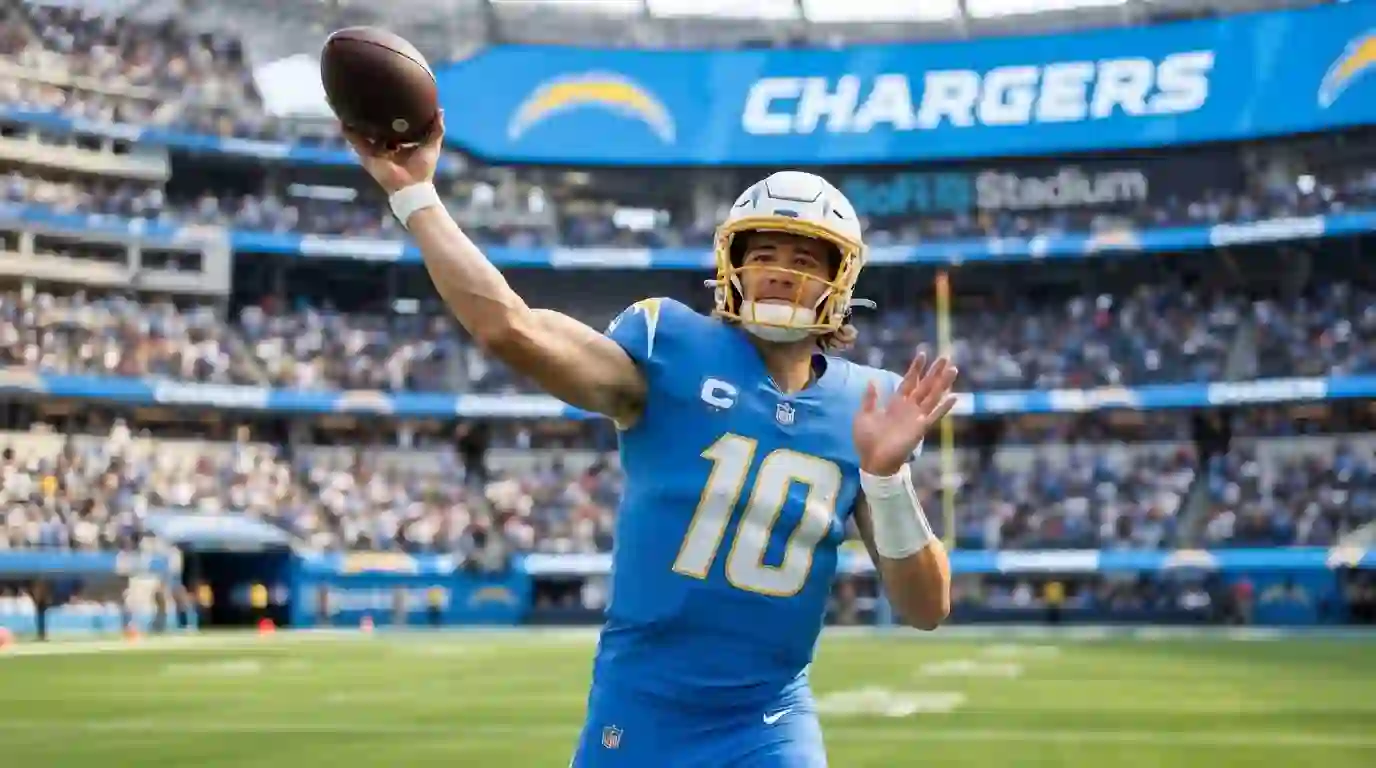
Full Stats, Box Score, and Game Analysis: Justin Herbert Leads Chargers to 34-17 Win
Title & Intro
| Biography | Details |
|---|---|
| Full Name | Justin Patrick Herbert |
| Born | March 10, 1998 (Age 28) — Eugene, Oregon |
| Team | Los Angeles Chargers (since 2020) |
| Position | Quarterback, Jersey No. 10 |
| Height / Weight | 6’6″ / 236 lbs |
| College | University of Oregon (2016–2019) |
| NFL Draft | 2020, Round 1, Pick 6 overall |
| Honors | 2020 Offensive Rookie of the Year, 2x Pro Bowl (incl. 2026 Pro Bowl) |
| 2025 Season Stats | 3,727 passing yards, 26 TD, 13 INT, 94.1 rating, 498 rushing yards |
| Career Stats (through 2025) | 24,820 passing yards, 163 touchdown passes |
Hook: Justin Herbert leads the Chargers to victory over the Cowboys, posting a 132.8 passer rating in a 34-17 road rout.
The Lead
Box scores record results; they rarely explain them. Fans who watched Justin Herbert light up AT&T Stadium on December 21, 2025 saw a masterclass, yet the final 34-17 score hides how it happened. This breakdown digs into the complete game data — team stats, quarter-by-quarter swings, and every key player line — so you know exactly how the Chargers quarterback drove his team to victory.
The Week 16 clash kicked off at 1:00 p.m. ET on Sunday, December 21, 2025, in front of an announced crowd of 92,740 inside AT&T Stadium in Arlington, Texas, broadcast nationally on FOX. Los Angeles entered at 10-4 and left at 11-4, while Dallas slipped to 6-8-1. The Chargers built the win on a 27-0 run that started late in the second quarter, with Herbert completing 23 of 29 passes for 300 yards and two touchdowns while adding a 1-yard touchdown sneak — all without a sack or an interception. Since then, Herbert’s most recent outing came in preseason action on August 20, 2026, when the Chargers fell 41-17 to the 49ers at SoFi Stadium; that box score gets a full breakdown further down.
Match Overview Table
| Information | Match Details |
|---|---|
| Event | NFL Regular Season — Week 16, 2025 Season |
| Game | Los Angeles Chargers vs Dallas Cowboys |
| Date | Sunday, December 21, 2025 |
| Venue | AT&T Stadium, Arlington, Texas |
| Attendance | 92,740 |
| Winner | Los Angeles Chargers |
| Final Score | Chargers 34, Cowboys 17 |
| Broadcast | FOX (streaming on NFL+, FOX Sports App) |
Core Match Statistics Overview
| Team Metric | Chargers | Cowboys |
|---|---|---|
| First Downs | 24 | 18 |
| Total Yards | 452 | 340 |
| Passing Yards (net) | 300 | 249 |
| Rushing Yards | 152 | 91 |
| Rushing Attempts | 33 | 23 |
| Sacks Allowed | 0 | 1 |
| Turnovers | 0 | 1 |
| Third Down Conversion | 7-11 (63.6%) | 4-9 (44.4%) |
| Fourth Down Conversion | 0-1 | 1-3 |
| Penalties | 4 for 34 yards | 5 for 40 yards |
| Time of Possession | 34:27 | 25:33 |
Herbert’s Passing Efficiency
The gap between the two passing attacks was bigger than the raw yardage suggests. Justin Herbert’s game stats included a 79.3 percent completion rate and 10.3 yards per attempt, while Dak Prescott finished at 70 percent and 8.1 yards per attempt.
- Herbert posted a 132.8 passer rating without a sack, an interception, or a single negative play created by Dallas’ pass rush.
- Prescott’s 116.5 rating was respectable, but he took a sack, lost a fumble through backup Joe Milton, and never completed a pass longer than 38 yards.
Ground Control
This was a running-game mismatch disguised by the passing stats. The Chargers ground out 152 yards on 33 carries with two touchdowns, while the Cowboys managed 91 yards on 23 totes and never found the end zone on the ground.
- Los Angeles converted that rushing production into a 34:27 to 25:33 time-of-possession edge, wearing down a Dallas defense that played 72 snaps.
- Omarion Hampton carried 16 times for 85 yards and the game-sealing touchdown, with Herbert chipping in 42 yards on eight scrambles.
Third-Down Discipline
The down-and-distance numbers tell a clean story: the Chargers moved the chains at a 63.6 percent clip on third down against a Cowboys unit that could only answer at 44.4 percent.
- Seven of Los Angeles’ 11 third-down attempts ended in conversions, keeping drives alive and the Dallas offense off the field.
- Dallas converted just four of nine and went 1-for-3 on fourth down, including a failed fourth-quarter gamble that handed the Chargers a short field.
Ball Security
Turnovers decided the margin more than any single play. The Chargers finished with zero giveaways; the Cowboys lost a fumble and never recovered one of their own.
- Herbert’s only blemish, a fumble on a scramble, was recovered by his own offense.
- Joe Milton’s fumble on a late possession gave the Chargers the ball in Dallas territory and directly preceded Omarion Hampton’s touchdown.
Period-by-Period Analysis
First Quarter (Tied 7-7)
| Team | Q1 |
|---|---|
| Chargers | 7 |
| Cowboys | 7 |
- Dallas scripted a 10-play opening drive capped by a 5-yard Dak Prescott touchdown pass to Ryan Flournoy, grabbing a 7-0 lead at the 10:20 mark.
- Justin Herbert answered on the next possession with a 23-yard touchdown strike to Quentin Johnston at 6:43, erasing the deficit in under four minutes.
- The quarter closed with both defenses settling in, but the tone was set: both quarterbacks came to throw early.
Second Quarter (Chargers 14, Cowboys 10)
| Team | Q2 |
|---|---|
| Chargers | 14 |
| Cowboys | 10 |
- Brandon Aubrey’s 33-yard field goal at 14:04 pushed Dallas back in front, but Herbert responded with a 25-yard touchdown to Ladd McConkey at 9:45 for a 14-10 edge.
- George Pickens’ 38-yard touchdown grab at 8:08 put the Cowboys up 17-14 — the last lead Dallas would hold all afternoon.
- Herbert closed the half with a 1-yard quarterback sneak with 19 seconds left, capping a two-minute drill that flipped the scoreboard to 21-17 at the break.
Third Quarter (Chargers 3, Cowboys 0)
| Team | Q3 |
|---|---|
| Chargers | 3 |
| Cowboys | 0 |
- Cameron Dicker’s 37-yard field goal at 11:51 stretched the lead to 24-17 after the Chargers stalled just outside the red zone.
- Dallas’ offense went quiet, managing just one drive of consequence while the Chargers controlled the tempo with a steady diet of Hampton carries.
- The Cowboys’ halftime adjustments produced nothing: no points, no explosive plays, and mounting frustration on the sideline.
Fourth Quarter (Chargers 10, Cowboys 0)
| Team | Q4 |
|---|---|
| Chargers | 10 |
| Cowboys | 0 |
- Dicker’s 27-yard field goal at 8:57 made it a two-possession game at 27-17 after another long, methodical Chargers drive.
- Omarion Hampton sealed it with a 5-yard touchdown run at 4:48, finishing a drive that chewed more than four minutes off the clock.
- Dallas’ final hopes died with a fumble on their next possession, and the Chargers ran out the clock to complete a 27-0 run dating back to the second quarter.
Detailed Team Player Statistics
Justin Herbert Game Stats & Chargers Player Statistics
Justin Herbert — Quarterback
| Stat | Value |
|---|---|
| Passing | 23/29, 300 yards, 2 TD, 0 INT |
| Passer Rating | 132.8 |
| Rushing | 8 carries, 42 yards, 1 TD |
| Sacks Taken | 0 |
| Total Touchdowns | 3 |
Herbert’s performance was the definition of controlled aggression: 10.3 yards per attempt, zero turnovers, and a perfect marriage of vertical shots and scramble production. His 1-yard sneak just before halftime flipped momentum for good, and his 34-yard scramble was the longest run by any Charger on the day.
Quentin Johnston — Wide Receiver
| Stat | Value |
|---|---|
| Receptions | 4 |
| Receiving Yards | 104 |
| Touchdowns | 1 |
| Long Reception | 50 yards |
Johnston delivered the chunk plays Los Angeles needed, including a 50-yard catch-and-run that set up points and a 23-yard touchdown to answer Dallas’ opening score. He averaged 26 yards per catch and drew the Cowboys’ top coverage all afternoon.
Omarion Hampton — Running Back
| Stat | Value |
|---|---|
| Carries | 16 |
| Rushing Yards | 85 |
| Touchdowns | 1 |
| Receptions | 1 (10 yards) |
Hampton did the dirty work between the tackles, wearing down Dallas’ front with 85 bruising yards and the game-sealing 5-yard touchdown. His late-game runs turned a 10-point lead into a clock-draining exercise.
Ladd McConkey — Wide Receiver
| Stat | Value |
|---|---|
| Receptions | 4 |
| Receiving Yards | 43 |
| Touchdowns | 1 |
| Targets | 6 |
McConkey caught the 25-yard touchdown that gave Los Angeles its first lead, and his route-running kept chains moving on third down. He was Herbert’s most-targeted receiver and the safety valve that made the deep shots to Johnston possible.
Dallas Cowboys Player Statistics
Dak Prescott — Quarterback
| Stat | Value |
|---|---|
| Passing | 21/30, 244 yards, 2 TD, 0 INT |
| Passer Rating | 116.5 |
| Rushing | 2 carries, 14 yards |
| Sacks Taken | 1 |
Prescott played a genuinely strong game in the first half, throwing touchdowns to Flournoy and Pickens with clean mechanics. But Dallas managed just 58 yards of offense on its final six possessions, and Prescott couldn’t manufacture a single scoring drive after halftime.
George Pickens — Wide Receiver
| Stat | Value |
|---|---|
| Receptions | 7 |
| Receiving Yards | 130 |
| Touchdowns | 1 |
| Long Reception | 38 yards |
Pickens was the only consistent weapon in Dallas’ passing game, hauling in seven of nine targets for 130 yards and a 38-yard touchdown. He accounted for more than half of Prescott’s passing yardage, which made him the sole focus of Chargers defensive coordinator Jesse Minter’s second-half adjustments.
CeeDee Lamb — Wide Receiver
| Stat | Value |
|---|---|
| Receptions | 6 |
| Receiving Yards | 51 |
| Touchdowns | 0 |
| Targets | 7 |
Lamb was efficient but muted, catching six passes for just 51 yards and never threatening the end zone. The Chargers’ coverage bracketed him all day, and the Cowboys never found a way to free him for the chunk plays that defined his best games.
Javonte Williams — Running Back
| Stat | Value |
|---|---|
| Carries | 9 |
| Rushing Yards | 34 |
| Touchdowns | 0 |
| Receptions | 2 (9 yards) |
Williams led a Dallas ground game that never got traction, averaging just 3.8 yards per carry as part of a 91-yard team effort. With the run game stalled, the Cowboys became one-dimensional, and their offense cratered in the second half.
Statistical Leaders Summary Table
| Category | Chargers | Cowboys |
|---|---|---|
| Leading Passer | Justin Herbert (300 yards, 2 TD) | Dak Prescott (244 yards, 2 TD) |
| Top Receiver | Quentin Johnston (4 rec, 104 yards, 1 TD) | George Pickens (7 rec, 130 yards, 1 TD) |
| Leading Rusher | Omarion Hampton (16 carries, 85 yards, 1 TD) | Javonte Williams (9 carries, 34 yards) |
| Top Defender | Tuli Tuipulotu (1 sack, 1 fumble recovery) | Shavon Revel (9 tackles, 1 PD) |
| Most Total Touchdowns | Justin Herbert (3: 2 pass, 1 rush) | Dak Prescott (2 passing) |
Analytical Breakdowns: Why They Won / Why They Lost
Why the Chargers Won
Herbert’s Precision Passing
Justin Herbert’s box score — 23-for-29, 300 yards, two touchdowns, no interceptions, no sacks — was the cleanest quarterback line of Week 16.
| Metric | Herbert | Prescott |
|---|---|---|
| Completion % | 79.3% | 70.0% |
| Yards per Attempt | 10.3 | 8.1 |
| Passer Rating | 132.8 | 116.5 |
| Sacks | 0 | 1 |
A Clean Pocket All Afternoon
Dallas’ defensive line, expected to pressure Herbert into mistakes, never touched him. The Chargers’ offensive line allowed zero sacks against a Cowboys front that had generated pressure all season, giving Herbert time to push the ball downfield.
- Los Angeles threw 29 times and absorbed zero sacks — a rarity against a Dallas defense built on interior disruption.
- Herbert’s only turnover threat, a fumble, was recovered by the offense, keeping the giveaway column at zero.
The 27-0 Run
From the moment Pickens scored to make it 17-14 in the second quarter, the Chargers outscored Dallas 27-0 across the final 33 minutes of game time.
- Three scoring drives (touchdown, field goal, field goal) were answered by three Dallas punts and a fumble.
- The Cowboys never crossed the Los Angeles 40-yard line in the fourth quarter.
Ground Control and the Clock
The Chargers ran 62 plays, held the ball for 34:27, and finished with 152 rushing yards. That combination kept Prescott on the sideline and Dallas’ pass rush on empty.
| Metric | Chargers | Cowboys |
|---|---|---|
| Time of Possession | 34:27 | 25:33 |
| Rushing Yards | 152 | 91 |
| Third Down % | 63.6% | 44.4% |
Why the Cowboys Lost
Pickens or Nothing Downfield
Dallas’ passing game funneled through one target. George Pickens caught seven passes for 130 yards; every other receiver combined for 114 yards on 16 catches, and no non-Pickens receiver produced a play longer than 18 yards.
- Once the Chargers shaded coverage toward Pickens in the second half, the Cowboys’ offense had no counterpunch.
- CeeDee Lamb’s 51 yards on seven targets showed the problem: volume without explosion.
A Ground Game That Never Got Started
The Cowboys rushed 23 times for 91 yards and zero touchdowns, and 34 of those yards came from the two backs who weren’t named Williams and Davis. With the run game neutralized, Dallas faced constant second-and-long situations.
- The 4.0 yards-per-carry average was respectable; the 23 attempts were not enough against a defense daring them to stay balanced.
- Dallas never committed to the run when trailing, and the Chargers’ front seven feasted on predictable pass calls.
Third-Down and Fourth-Down Failure
Dallas converted 4 of 9 third downs and 1 of 3 fourth downs, including a failed fourth-quarter attempt that led directly to field position for the Chargers’ sealing touchdown.
- The 1-for-3 fourth-down mark included a turnover on downs that handed Los Angeles the ball in plus territory.
- Five penalties for 40 yards erased two third-down conversions and kept the Cowboys behind the chains.
Historical Context & Advanced Insights
Head-to-Head: Justin Herbert vs the Cowboys
| Date | Venue | Result |
|---|---|---|
| September 19, 2021 | SoFi Stadium | Cowboys 20-17 |
| October 16, 2023 | SoFi Stadium | Cowboys 20-17 |
| December 21, 2025 | AT&T Stadium | Chargers 34-17 |
This was Justin Herbert’s first career win over Dallas. The previous two meetings were identical 20-17 Cowboys wins, including a 2021 heartbreaker decided by Greg Zuerlein’s 56-yard field goal as time expired and a 2023 Monday Night Football loss sealed by Stephon Gilmore’s late interception. The 34-17 margin in Arlington was the largest in the series since 2017 and gave the Chargers a 27-13 all-time record against Dallas.
Advanced Statistical Insights
Pro-Football-Reference’s expected points model tells a fascinating story: the Chargers finished plus-17.0 total EPA, powered by a plus-23.89 offensive EPA, while the Cowboys’ defense produced a minus-23.89 EPA — the widest gap on the field. Dallas actually generated positive EPA through the air (plus-13.44), but their rushing EPA cratered to minus-7.21 and their defense was eviscerated.
The efficiency gap shows up in per-play terms: Los Angeles gained 7.3 yards per play against Dallas’ 6.1, and the Chargers needed just 62 plays to generate 452 yards. Herbert’s assist-to-score ratio, if you will, was perfect — he threw 29 passes, completed 23, and finished with three touchdowns and zero giveaways, a combination that computes to a 132.8 passer rating and a 100 percent scoring-possession rate inside Dallas territory.
Most Recent Action: 49ers 41-17 Chargers (Preseason Week 2, August 20, 2026)
Herbert’s most recent box score came in preseason, and it was brief by design. The starter played one series at SoFi Stadium — a three-and-out that produced a 9-yard completion to tight end Charlie Kolar and nothing else, finishing 1-for-2 for 9 yards.
| Quarter | 49ers | Chargers |
|---|---|---|
| Q1 | 0 | 0 |
| Q2 | 20 | 3 |
| Q3 | 7 | 6 |
| Q4 | 14 | 8 |
| Final | 41 | 17 |
The 49ers pulled away on Jacob Cowing’s 83-yard punt return touchdown, Sincere McCormick’s 7-yard run, and two Adrian Martinez scores, while Los Angeles answered with Junior Colson’s 16-yard pick-six and a late DJ Uiagalelei touchdown pass to Jerand Bradley. The team stats were lopsided: San Francisco rolled up 321 yards and a 32:56 to 27:04 time-of-possession edge, while the Chargers managed 229 yards, converted just 2 of 14 third downs, and were flagged seven times. Trey Lance and Uiagalelei combined for 17-of-31 passing for 153 yards with one touchdown, underlining the depth concern behind Herbert as the Chargers prepped for the Rams on August 27.
Game Implications & Key Lessons
What This Means for the Chargers
- The win pushed Los Angeles to 11-4 and effectively locked in a playoff spot; the Chargers closed the season 11-6 and reached the wild-card round before falling 3-16 at New England.
- Herbert’s 2025 finish — 3,727 yards, 26 touchdowns, 13 interceptions, a 94.1 rating and a 2026 Pro Bowl nod — made him the engine of a playoff run that survived a battered offensive line and a broken hand.
- The formula that worked in Dallas — clean pockets, balanced runs, zero turnovers — became the blueprint the Chargers carried into the postseason.
What This Means for the Cowboys
- Dallas fell to 6-8-1 with the loss, essentially ending any realistic playoff hopes in a season that began with Super Bowl expectations.
- The offense’s dependence on George Pickens and the absence of a functional run game were structural problems, not one-game blips.
- A defense that entered the game among the league’s most disruptive units finished with zero sacks and zero takeaways, an alarming profile for a team that needed to win every remaining game.
Key Lessons
- Protecting the quarterback decided the game: Herbert took zero sacks against a Cowboys front that sacked Prescott once and had lived in backfields all season.
- The turnover battle is the single most predictive stat in football — the Chargers won it 1-0 and won the game by 17.
- Justin Herbert’s game stats at 10.3 yards per attempt prove efficiency beats volume: he threw nine fewer passes than Prescott for 56 more yards.
- Third-down conversion rates of 63.6 percent to 44.4 percent translated directly into a nine-minute possession gap.
- A 152-yard rushing day with two touchdowns turned the fourth quarter into a clock-draining exercise for the Chargers.
- Even the best quarterback needs answers around him: Dallas had one receiver and no run game, and the offense collapsed when the defense took Pickens away.
FAQ & Conclusion
Who won the Chargers vs Cowboys game on December 21, 2025?
The Los Angeles Chargers beat the Dallas Cowboys 34-17 at AT&T Stadium in Week 16 of the 2025 NFL season. The win improved the Chargers to 11-4 while dropping Dallas to 6-8-1.
What were Justin Herbert’s stats against the Cowboys?
Justin Herbert completed 23 of 29 passes for 300 yards with two touchdowns and no interceptions for a 132.8 passer rating. He added 42 rushing yards and a 1-yard touchdown run on eight carries, giving him three total touchdowns and zero turnovers.
Who were the top performers for each team?
For the Chargers, Quentin Johnston caught four passes for 104 yards and a touchdown, while Omarion Hampton rushed for 85 yards and a score. For the Cowboys, George Pickens led all receivers with seven catches for 130 yards and a touchdown, and Dak Prescott threw for 244 yards and two scores.
What was the halftime score?
The Chargers led 21-17 at halftime after Justin Herbert’s 1-yard touchdown sneak with 19 seconds left in the second quarter. Los Angeles then shut out Dallas in the second half, outscoring the Cowboys 13-0 after the break.
How did the Chargers overcome an early deficit?
Dallas led 17-14 in the second quarter, but the Chargers closed the game on a 27-0 run fueled by Herbert’s efficiency, a ground game that produced 152 yards, and a defense that blanked the Cowboys after halftime.
What happened in Justin Herbert’s most recent preseason game?
In the Chargers’ 41-17 preseason loss to the 49ers on August 20, 2026, Herbert played just one series and finished 1-of-2 for 9 yards with no touchdowns or interceptions before giving way to Trey Lance and DJ Uiagalelei.
Conclusion
The final score flattered Dallas. The Chargers won this game in the margins — zero sacks allowed, zero turnovers, a nine-minute possession advantage, and 27 unanswered points after falling behind — and every one of those margins traces back to how Herbert played within the structure around him. His 300-yard day was spectacular, but it was the sum of the pieces: a clean pocket, a punishing run game, and a defense that closed the door. The Cowboys had a star receiver and a capable quarterback; the Chargers had the complete team, and on this Sunday in Arlington, complete beat talented every time.