
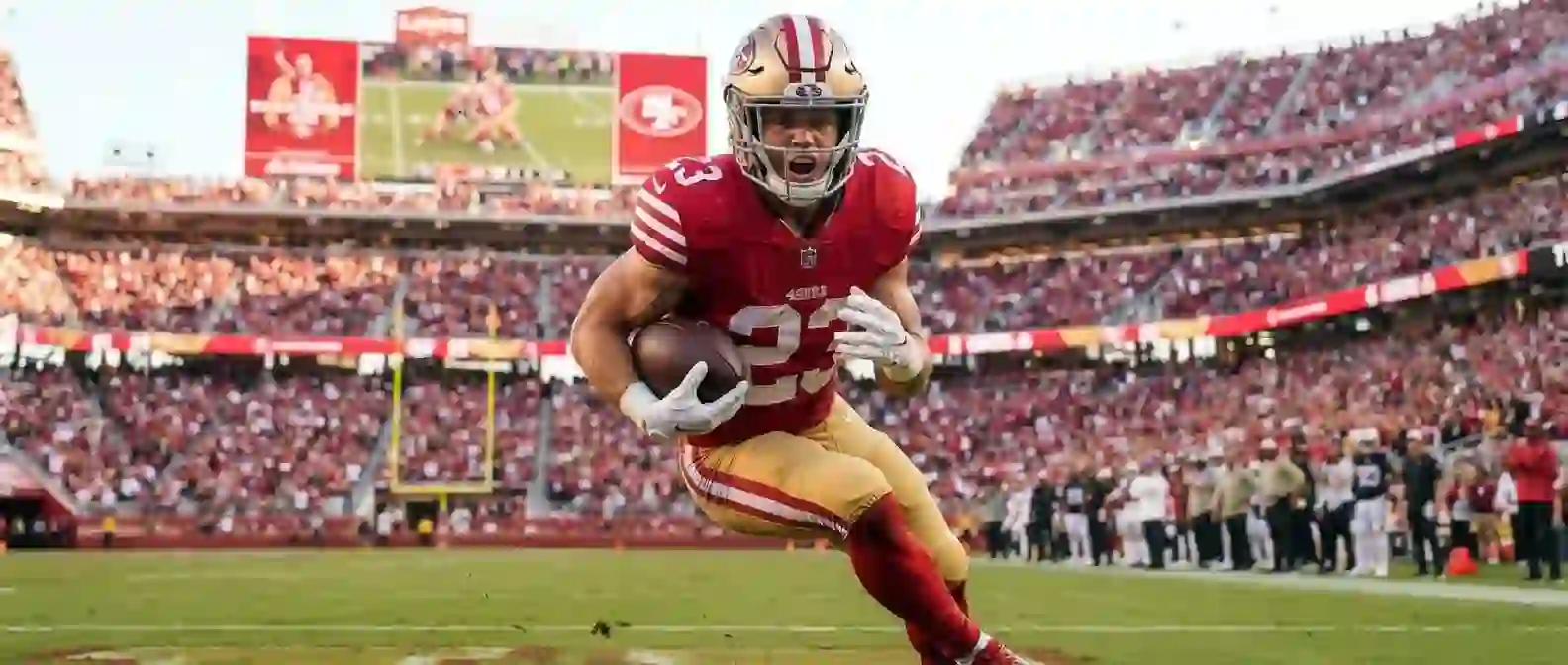
Christian McCaffrey: Biography, Stats, and the Three-Touchdown Masterclass That Lifted the 49ers Past the Cardinals
Christian McCaffrey just played his most complete game of the 2025 season, and a box score alone cannot explain it. Raw numbers without context hide why his three touchdowns broke the game open, or why Jacoby Brissett’s NFL-record 47 completions added up to nothing. This Christian McCaffrey stats breakdown pairs every number with the tactical story behind it, from an opening-play kickoff return to the red-zone execution that decided an NFC West showdown.
Christian McCaffrey Biography Table
| Biography Information | Player Details |
|---|---|
| Full Name | Christian Jackson McCaffrey |
| Born | June 7, 1996, Castle Rock, Colorado (age 29) |
| Height / Weight | 5 ft 11 in / 205 lb |
| Position | Running Back, No. 23 |
| College | Stanford (2014–2016) |
| NFL Draft | 2017, Round 1, Pick 8 — Carolina Panthers |
| NFL Teams | Carolina Panthers (2017–2022), San Francisco 49ers (2022–present) |
| Career Honors | AP NFL Offensive Player of the Year (2023), multiple First-Team All-Pro and Pro Bowl selections, All-Pro honors again in 2025 |
| Career NFL Stats (through 2025) | 7,589 rushing yards, 62 rushing TDs, 626 receptions, 5,390 receiving yards, 36 receiving TDs |
| Signature Records | One of only three players in NFL history with 1,000 rushing and 1,000 receiving yards in one season; only running back with three 100-catch seasons; 49ers-record 17 consecutive games with a touchdown |
| 2025 Season Output | 1,202 rushing yards, 924 receiving yards, 17 total TDs, NFL-leading 413 touches |
The Lead
On November 16, 2025, in front of 65,032 fans at State Farm Stadium in Glendale, Arizona, the San Francisco 49ers dismantled the Arizona Cardinals 41-22 in a Week 11 NFC West collision. San Francisco needed only 281 yards of total offense to hang 41 points on the board, because nearly every drive ended in points and every Arizona mistake ended in worse. Christian McCaffrey scored three touchdowns — a 1-yard plunge 16 seconds after kickoff, a 9-yard catch, and a fourth-quarter dagger — while Brock Purdy returned from a toe injury to throw three touchdown passes without a turnover.
The strange part of this 49ers vs Cardinals clash is that Arizona out-gained San Francisco by 207 yards. Jacoby Brissett completed an NFL-record 47 passes for 452 yards, Michael Wilson posted a career-best 15 catches, and the Cardinals still lost by 19. Three turnovers, 17 penalties for 130 yards, a dormant running game, and a defense that could not get off the field in the red zone turned a statistical monsoon into a blowout loss. Here is the full breakdown of how it happened.
Match Overview Table
| Information | Match Details |
|---|---|
| Event | NFL Week 11, NFC West (2025 Regular Season) |
| Game | San Francisco 49ers vs Arizona Cardinals |
| Date | November 16, 2025 |
| Venue | State Farm Stadium, Glendale, Arizona |
| Attendance | 65,032 |
| Winner | San Francisco 49ers |
| Final Score | 49ers 41, Cardinals 22 |
| Broadcast | Fox (Kevin Kugler, Daryl Johnston), streamed on Fubo |
Core Match Statistics: 49ers vs Cardinals Team Comparison
The team stats sheet from this NFL Week 11 showdown reads like an optical illusion. Arizona posted 488 yards to San Francisco’s 281, controlled the clock for over 34 minutes, and converted third downs at a higher rate. The 49ers won the only columns that decide games: turnovers, red-zone efficiency, penalties, and points.
| Team Statistic | San Francisco 49ers | Arizona Cardinals |
|---|---|---|
| Total Yards | 281 | 488 |
| Net Passing Yards | 186 | 452 |
| Completions – Attempts | 19 – 26 | 47 – 57 |
| Passing TDs – INTs | 3 – 0 | 2 – 2 |
| Rushing Yards – Avg | 95 – 3.8 | 36 – 2.6 |
| First Downs | 24 | 24 |
| Third-Down Conversions | 3 of 9 (33%) | 6 of 14 (43%) |
| Red-Zone Efficiency | 4 of 5 (80%) | 3 of 5 (60%) |
| Turnovers | 0 | 3 |
| Sacks Allowed | 1 | 0 |
| Penalties – Yards | 1 – 15 | 17 – 130 |
| Time of Possession | 25:45 | 34:15 |
Passing Volume vs. Passing Efficiency
- Brock Purdy generated 200 yards on just 26 attempts (7.7 per throw) with a 133.5 passer rating, moving the chains on 48.1% of his dropbacks, while Brissett’s 47 completions produced a first down only 31.6% of the time.
- Nearly half of Brissett’s production (198 yards) came after the catch, a sign of a dink-and-dunk attack content to bleed clock; Purdy averaged more air yards per attempt (7.2 to 6.8) despite throwing 31 fewer passes.
Ball Security Decided the Turnover Battle
- San Francisco finished plus-3 in turnover margin: Deommodore Lenoir’s 64-yard interception return and Malik Mustapha’s pick just before halftime, plus Keion White’s fumble recovery.
- Pro Football Reference’s expected points model credited the 49ers with +13.1 points from turnovers alone — nearly the entire first-half margin Arizona spent the afternoon chasing.
Red-Zone Execution and Scoring Efficiency
- The 49ers scored touchdowns on 4 of 5 red-zone trips, and Christian McCaffrey touchdowns came from 1, 9, and 4 yards out — three finishes inside the 10-yard line.
- Arizona settled for 3 of 5, including a missed 58-yard Chad Ryland field goal after Greg Dortch’s 40-yard punt return gave the Cardinals short-field momentum in the second quarter.
Special Teams and Hidden Yardage
- Skyy Moore’s 98-yard kickoff return on the game’s opening play and Brian Robinson Jr.’s 42-yard return generated +15.8 expected points on kickoff returns alone for San Francisco.
- Eddy Piñeiro nailed all three field goals (48, 47, 47 yards), including a 47-yarder on the final snap of the first half after an Arizona penalty wiped out a blocked kick and forced a re-kick.
Quarter-by-Quarter: NFL Week 11 Momentum Breakdown
First Quarter — 49ers 13, Cardinals 7
| Team | Q1 Score | Running Total |
|---|---|---|
| 49ers | 13 | 13 |
| Cardinals | 7 | 7 |
- Moore’s 98-yard return flipped the field instantly, and McCaffrey walked in from a yard out 16 seconds into the game — the fastest score of his 49ers tenure.
- Purdy’s 30-yard touchdown to George Kittle capped a five-play, 70-yard drive on which the quarterback went 3-for-4; the extra point was blocked, a rare 49ers special-teams wobble.
- Zonovan “Bam” Knight answered with a 6-yard touchdown run to end a 72-yard drive, briefly making this look like a shootout before San Francisco’s defense tightened.
Second Quarter — 49ers 12, Cardinals 3
| Team | Q2 Score | Halftime Score |
|---|---|---|
| 49ers | 12 | 25 |
| Cardinals | 3 | 10 |
- McCaffrey’s 9-yard touchdown grab finished a 52-yard drive that began with excellent field position after Ryland’s missed 58-yard field goal.
- Arizona’s defense forced two field goals in the final minute of the half, but a 15-yard penalty on the blocked attempt let Piñeiro re-kick from 47 yards as time expired — a five-point swing built purely on discipline failures.
- The Cardinals left the half with 11 penalties for 81 yards and a Brissett interception in the final 30 seconds, trailing by 15 despite out-gaining San Francisco in total offense.
Third Quarter — 49ers 10, Cardinals 0
| Team | Q3 Score | Score After Three |
|---|---|---|
| 49ers | 10 | 35 |
| Cardinals | 0 | 10 |
- Piñeiro’s third field goal, a 47-yarder, stretched the lead to 18 after an Arizona drive stalled deep in 49ers territory.
- Lenoir intercepted Brissett and raced 64 yards to the Arizona 14; two plays later, Kittle’s 4-yard touchdown — the 50th scoring catch of his career — made it 35-10 and ended the competitive phase of the game.
- Arizona ran 14 third-quarter plays and crossed midfield twice with zero points, the defining stretch of empty offense in the entire 49ers game recap.
Fourth Quarter — 49ers 6, Cardinals 12
| Team | Q4 Score | Final Score |
|---|---|---|
| 49ers | 6 | 41 |
| Cardinals | 12 | 22 |
- Trey McBride’s 10-yard touchdown and Greg Dortch’s 17-yarder made the final margin respectable, but both two-point conversions failed, keeping the Cardinals three scores behind.
- McCaffrey’s third score — a 4-yard run with 4:44 left — answered McBride’s touchdown and killed any comeback whisper before it started.
- Kyle Shanahan emptied the backfield from there, with Mac Jones closing out victory formation as the 49ers improved to 7-4 and dropped Arizona to 3-7.
San Francisco 49ers Player Statistics
Christian McCaffrey Stats: 18 Touches, 121 Yards, 3 Touchdowns
| Category | Rushing | Receiving | Total |
|---|---|---|---|
| Volume | 13 carries | 5 catches (6 targets) | 18 touches |
| Yards | 81 (6.2 per carry) | 40 | 121 scrimmage |
| Touchdowns | 2 | 1 | 3 |
| First Downs | 7 | 3 | 10 |
McCaffrey turned 10 of his 18 touches into either a first down or a touchdown, the fifth three-score game of his career and his first of the 2025 season. After failing to find the end zone on the ground in the season’s first five weeks, he ripped off six rushing touchdowns across a six-game span, punishing an Arizona front that never solved his combination of patience and burst. His Christian McCaffrey fantasy points line of 35.0 in PPR formats ranked second among all running backs that week.
Brock Purdy — 19 of 26, 200 Yards, 3 TD, 133.5 Rating
| Category | Completions | Yards | TD | INT | Rating |
|---|---|---|---|---|---|
| Passing | 19 of 26 (73.1%) | 200 | 3 | 0 | 133.5 |
Returning from a toe injury that had sidelined him, Purdy was near flawless: one bad throw on 26 attempts, zero drops from his receivers, and touchdowns of 30 yards to Kittle, 9 to McCaffrey, and 4 back to Kittle. He attacked downfield when the playbook allowed and took just one sack, protecting both the football and the scoreboard in a game San Francisco never trailed by a point.
George Kittle — 6 Catches, 67 Yards, 2 TD
| Category | Receptions | Yards | TD | Long |
|---|---|---|---|---|
| Receiving | 6 (6 targets) | 67 | 2 | 30 |
Kittle converted all six of his targets into catches, five of them moving the chains, and his 30-yard touchdown showcased the run-after-catch violence that still separates him from every tight end not named Kelce. The second score, the 50th receiving touchdown of his career, arrived two plays after Lenoir’s 64-yard interception return and effectively closed the game in the third quarter.
Jauan Jennings and the Supporting Cast
| Player | Receptions | Yards | Notes |
|---|---|---|---|
| Jauan Jennings | 4 (6 targets) | 54 | 25-yard catch sparked first TD drive |
| Kyle Juszczyk | 2 | 26 | 21-yard long |
| Brian Robinson Jr. | 8 carries, 24 rush yds | 42-yard KR | Dual-threat depth |
Jennings delivered the 25-yard deep shot that launched Kittle’s first touchdown and consistently moved sticks from the slot. With Ricky Pearsall and Demarcus Robinson held quiet, his physicality and Robinson’s kickoff return gave the offense short fields all afternoon.
Arizona Cardinals Player Statistics
Jacoby Brissett — NFL-Record 47 Completions in a Losing Effort
| Category | Completions | Yards | TD | INT | Rating |
|---|---|---|---|---|---|
| Passing | 47 of 57 (82.5%) | 452 | 2 | 2 | 96.8 |
Brissett broke the NFL single-game regular-season completions record previously shared by Jared Goff and Drew Bledsoe at 45, and his jersey went to the Pro Football Hall of Fame in Canton — all in a 19-point loss. Making his fifth straight start for the injured Kyler Murray (foot, injured reserve), he spread the ball to nine different receivers and never took a sack, but two interceptions and a pile of checkdowns produced points far too slowly to matter.
Michael Wilson — 15 Catches, 185 Yards, Career Day
| Category | Receptions | Yards | Targets | Long |
|---|---|---|---|---|
| Receiving | 15 | 185 | 18 | 34 |
Elevated to WR1 duty with Marvin Harrison Jr. sidelined, the third-year Stanford product set career highs across the board and recorded nine first downs, including a contested 34-yard grab that lit up the highlight reels. He and McCaffrey, two products of the same college program, traded big plays all afternoon in one of the quietest 185-yard performances of the season because it came with zero touchdowns and zero scoreboard impact.
Trey McBride — 10 Catches, 115 Yards, 1 TD
| Category | Receptions | Yards | TD | Long |
|---|---|---|---|---|
| Receiving | 10 | 115 | 1 | 28 |
McBride was Brissett’s security blanket over the middle, and his 10-yard touchdown with 8:28 left gave Arizona brief life at 35-16. Like the rest of the Cardinals’ passing game, his production came in garbage-time rhythm — 46 of his yards came after the catch as the 49ers conceded underneath throws while protecting a three-score lead.
Greg Dortch and Zonovan Knight — The Only Ground Support
| Player | Stat Line | Scoring |
|---|---|---|
| Greg Dortch | 6 catches, 66 yds; 3 KR, 79 yds; 2 PR, 51 yds | 17-yard TD |
| Zonovan Knight | 5 carries, 24 yds | 6-yard TD run |
Dortch was Arizona’s best all-purpose weapon, adding a 40-yard punt return to his team-leading total of 196 all-purpose yards. Knight scored the Cardinals’ only rushing touchdown of the day on a ground game that managed 36 yards total — a 2.6-yard average that let San Francisco’s defense tee off on obvious passing downs.
Statistical Leaders Summary Table
| Category | San Francisco 49ers | Arizona Cardinals |
|---|---|---|
| Leading Scorer | Christian McCaffrey (18 points — 3 TD) | Knight, McBride, Dortch (6 points each) |
| Second Leading Scorer | George Kittle (12 points — 2 TD) | Chad Ryland (4 points — FG + XP) |
| Top Rebounder/Defense | Deommodore Lenoir (INT, 64-yd return, 2 PD, 7 tackles) | Cody Simon (12 tackles), Budda Baker (8) |
| Most Assists/Playmaker | Brock Purdy (200 pass yds, 3 TD, 0 TO) | Jacoby Brissett (452 pass yds, 2 TD) |
Why the San Francisco 49ers Won
Surgical Red-Zone Offense
The 49ers scored five offensive touchdowns on drives that averaged just 47.6 yards, because Moore’s return, turnovers, and punts consistently handed Purdy a short field. Four of five red-zone trips ended in touchdowns, and all three of McCaffrey’s scores came from inside the 10-yard line.
| Red-Zone Metric | 49ers | Cardinals |
|---|---|---|
| Trips | 5 | 5 |
| Touchdowns | 4 | 3 |
| TD Rate | 80% | 60% |
| Shortest TD Drive | 1 play, 1 yard (after 98-yd KR) | 9 plays, 72 yards |
Plus-3 in the Turnover Battle
Every 49ers takeaway converted into points. Mustapha’s interception closed the first half, White’s fumble recovery bled the clock, and Lenoir’s 64-yard return set up Kittle’s clinching score at the Arizona 14. San Francisco’s expected-points swing from turnovers was +13.1 — essentially a two-touchdown head start generated by defense.
| Turnover | 49er Responsible | Points Following Drive |
|---|---|---|
| INT (0:26, Q2) | Malik Mustapha | 3 (Piñeiro 47-yd FG) |
| Fumble recovery | Keion White | 7 (McCaffrey 4-yd TD) |
| INT (Q3) | Deommodore Lenoir, 64-yd return | 7 (Kittle 4-yd TD) |
Discipline and Complementary Football
Arizona was flagged 17 times for 130 yards; San Francisco took one penalty for 15. The 49ers’ kick-return unit posted +15.8 expected points, their offense committed zero turnovers, and Purdy threw one bad pass in 26 attempts. When a team wins hidden-yardage battles this decisively, it can be out-gained by 207 yards and still win by 19 — a textbook 49ers game recap study in complementary football.
Why the Arizona Cardinals Lost
Historic Volume, Hollow Efficiency
Brissett’s 47 completions produced 22 points — one point for every 22.2 yards gained, compared to San Francisco’s one point per 6.9 yards. Only 18 of his 57 attempts moved the chains, and the two-minute offense that dominated garbage time needed three-score deficits to find rhythm. Volume records built on checkdowns are stats, not solutions.
Self-Inflicted Wounds
Seventeen penalties for 130 yards, two failed two-point conversions, a missed 58-yard field goal, and a blocked-kick penalty that handed the 49ers three free points — Arizona beat itself in every phase. The re-kick before halftime alone flipped a 19-10 game to 25-10, and the Cardinals never again trailed by fewer than 15.
A Rushing Attack That Threatened Nothing
Arizona’s 36 rushing yards averaged 2.6 per carry, and no Cardinals running back managed a gain longer than Knight’s 12-yard reception. Without credible play-action, San Francisco’s defenders sat on routes, sacked nothing, and allowed 452 yards of inconsequence — the 49ers’ pass rush sacrificed pressure for coverage, and it worked precisely because the run game gave them nothing to fear.
Historical Context: Season Series and Advanced Insights
2025 Season Series Breakdown
San Francisco swept the season series, avenging Arizona’s 2024 sweep and extending a run of dominance that includes a 2023 sweep as well.
| Meeting | Date | Venue | Result | McCaffrey Line |
|---|---|---|---|---|
| Week 3 | Sept 21, 2025 | Levi’s Stadium | 49ers 16, Cardinals 15 | 140 scrimmage yds (17-52 rush, 10-88 rec) |
| Week 11 | Nov 16, 2025 | State Farm Stadium | 49ers 41, Cardinals 22 | 121 scrimmage yds, 3 TD |
The Week 3 escape — a one-point win with Mac Jones under center while Purdy and Kittle sat injured — already showed the pattern: McCaffrey carried the offense early, and the supporting cast finished. By Week 11, a healthy Purdy turned the same formula into a rout. In the bigger picture, this win steadied a 7-4 team that finished 12-5 and reached the playoffs, while Arizona spiraled to 3-14.
Advanced Statistical Insights: The Efficiency Chasm
The most revealing number of the afternoon is yards per point: San Francisco needed 6.9 yards for every point, Arizona 22.2. The 49ers’ offense operated like a scoring machine on a conveyor belt of short fields — five touchdown drives of 1, 70, 52, 14 (after the Lenoir return), and 45 yards — while Arizona strung together 10-play marches that ended in punts, picks, and failed conversions.
Pro Football Reference’s expected-points summary tells the same story: the 49ers finished +20.0 overall despite -9.9 from their pass defense, because special teams (+11.6) and turnover fortune (+13.1) overwhelmed Arizona’s raw yardage edge. Assist-to-field-goal thinking translates cleanly here — the 49ers’ “assist” equivalent was field position, and their conversion rate inside the 20 (80% touchdowns) turned borrowed yards into real points. Brissett’s 198 yards after the catch versus Purdy’s 77 exposes the difference in intent: Arizona’s passing game survived on what defenders conceded, San Francisco’s attacked on purpose, averaging more air yards per attempt on a third of the volume.
Game Implications and Key Lessons
What This Means for the 49ers
- The win pushed San Francisco to 7-4 and kept them locked into the NFC playoff picture; they finished 12-5 and returned to the postseason, validating the roster’s health-first second half.
- Purdy’s clean return answered the season’s biggest question mark, and a three-TD game from McCaffrey confirmed the engine was back to full power after his injury-wrecked 2024.
- The coaching staff found a repeatable formula — explosive special teams, red-zone precision, zero turnovers — that carried them through December.
What This Means for the Cardinals
- Arizona fell to 3-7 and never recovered, closing the season on a losing streak that ended at 3-14 and forced difficult offseason questions about the roster around Kyler Murray.
- Brissett’s record-setting efficiency in defeat strengthened the argument for a quarterback competition, or at minimum proved the passing-game infrastructure deserved better than its record.
- The 17-penalty, 36-rushing-yard performance identified the two areas — discipline and ground-game investment — that defined their losing season.
Key Lessons
- Turnovers and field position decide close statistical games faster than total yards: a plus-3 margin and a 98-yard return were worth more than 452 passing yards.
- Red-zone touchdown rate, not yardage, is the truest measure of offensive health — 80% versus 60% functioned as a 19-point swing.
- A dormant rushing attack (2.6 yards per carry) makes even record-breaking passing volume predictable and defensive-friendly.
- Penalty discipline compounds: Arizona’s re-kick penalty alone changed the halftime math by three points and the game’s psychology by more.
- Elite skill players raise floor and ceiling simultaneously — McCaffrey’s 18 touches produced 10 first downs or scores.
- Volume records without scoring efficiency are hollow; Brissett’s jersey went to Canton while his team went home with a 19-point loss.
Frequently Asked Questions
Who won the Week 11 game between the 49ers and Cardinals?
The San Francisco 49ers beat the Arizona Cardinals 41-22 on November 16, 2025, at State Farm Stadium in Glendale, Arizona, in front of 65,032 fans.
How did Christian McCaffrey perform against the Cardinals?
McCaffrey rushed 13 times for 81 yards and two touchdowns and caught 5 of 6 targets for 40 yards and a third score — 121 yards from scrimmage and 18 fantasy points before receptions in standard leagues, 35.0 in PPR formats.
How many touchdowns does Christian McCaffrey have in the 2025 season?
Through Week 11, McCaffrey had 15 total touchdowns (9 rushing, 6 receiving). He finished the 2025 regular season with 17 — 10 rushing and 7 receiving — alongside 1,202 rushing and 924 receiving yards.
What NFL record did Jacoby Brissett set in this game?
Brissett completed 47 of 57 passes, breaking the NFL single-game regular-season completions record of 45 shared by Jared Goff and Drew Bledsoe. The Pro Football Hall of Fame received his jersey.
Why wasn’t Kyler Murray playing for the Cardinals?
Murray was sidelined with a foot injury and had been placed on injured reserve, making Brissett Arizona’s starter for a fifth consecutive game.
Where did the NFC West standings land after this game?
The win moved the 49ers to 7-4 and into strong wild-card position — they finished 12-5 and reached the playoffs — while the Cardinals dropped to 3-7 on their way to a 3-14 finish.
The Final Word: Efficiency Beat Volume
This game settled an old argument in the loudest way possible. One offense threw for 452 yards and set an NFL record; the other needed 281 total yards to score 41 points. Christian McCaffrey’s three-touchdown day was the headline, but the story was structural — San Francisco converted short fields into touchdowns at an 80% red-zone clip, protected the football for 60 minutes, and let Arizona accumulate empty statistics against a prevent-defense shell. Teamwork, discipline, and situational efficiency didn’t just outperform individual brilliance in Week 11; they made it disappear from the scoreboard entirely.