
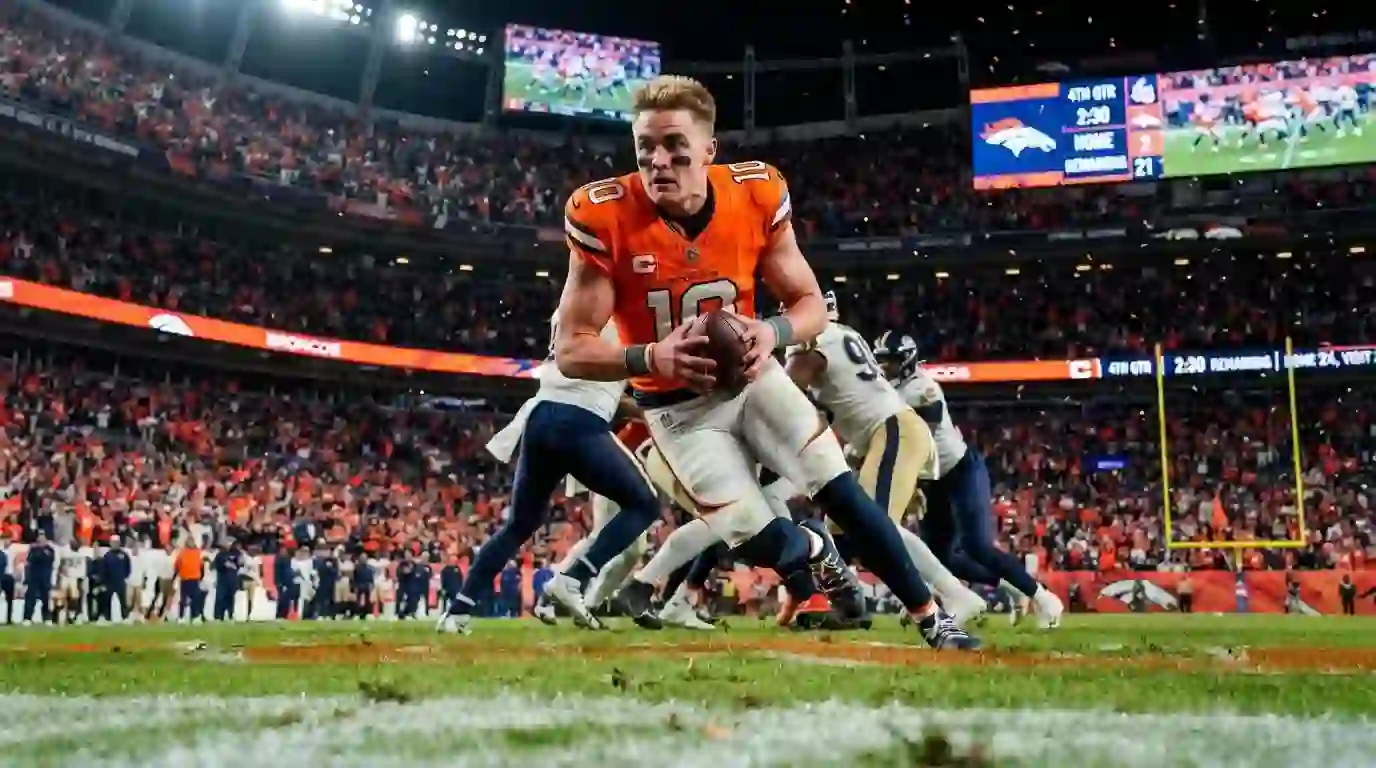
Searching for a clean, complete Bo Nix stat line from the AFC Divisional Round usually returns a headline number and nothing else. That is useless if you want to understand how Denver survived Buffalo. Box score fragments hide the turnover swing, the red-zone math, and the fourth-quarter sequence that flipped the game. This breakdown gives you every meaningful number from the 33-30 overtime win, organized so you can actually use it.
Bo Nix Player Profile
| Biography | Detail |
|---|---|
| Full Name | Bo Nix |
| Position | Quarterback |
| Jersey Number | 10 |
| Team | Denver Broncos |
| Born | February 25, 2000 |
| Height / Weight | 6’2″ / 217 lbs |
| College | Auburn (previously Oregon) |
| NFL Experience | Third season |
| 2025 Regular Season | 388-of-612, 3,931 yards, 25 TD, 11 INT, 83 carries for 356 yards, 5 rushing TD |
| Divisional Round Line | 26-of-46, 279 yards, 3 TD, 1 INT, 87.1 rating, 12 carries for 29 yards |
The Lead
Denver hosted Buffalo on Saturday, January 17, 2026 at Empower Field at Mile High, and 77,043 fans in 36-degree air watched a game that refused to end in regulation. The Broncos, the AFC’s No. 1 seed at 15-3, trailed 27-23 with under two minutes left after Josh Allen had spent an entire second half grinding Denver’s front. Nix answered with a 26-yard touchdown strike to Marvin Mims at 0:55, Matt Prater forced overtime with a 50-yard field goal at 0:05, and Wil Lutz ended it from 23 yards in the extra period.
The final was 33-30, and the number that explains it is five. Buffalo turned the ball over five times — three lost fumbles and two Josh Allen interceptions — against a single Denver giveaway. The Bills won first downs 28-22, rushing yards 183-70, and time of possession by nearly 12 minutes, and still lost. That is what a minus-four turnover margin buys you in January.
Match Overview Table
| Information | Match Details |
|---|---|
| Event | NFL Playoffs — AFC Divisional Round |
| Game | Buffalo Bills vs Denver Broncos |
| Date | Saturday, January 17, 2026 |
| Venue | Empower Field at Mile High, Denver, Colorado |
| Attendance | 77,043 |
| Winner | Denver Broncos |
| Final Score | Denver 33, Buffalo 30 (OT) |
| Broadcast | CBS / Paramount+ |
Core Match Statistics Overview
| Team Metric | Buffalo Bills | Denver Broncos |
|---|---|---|
| Total Yards | 449 | 349 |
| First Downs | 28 | 22 |
| Rushing (Att-Yds-TD) | 36-183-0 | 22-70-0 |
| Passing (C-A-Y-TD-INT) | 25-39-283-3-2 | 26-46-279-3-1 |
| Net Passing Yards | 266 | 279 |
| Sacks Allowed (Yards) | 3 (-17) | 0 (0) |
| Fumbles-Lost | 5-3 | 1-0 |
| Total Turnovers | 5 | 1 |
| Third Down Conversions | 10-15 (66.7%) | 8-16 (50.0%) |
| Fourth Down Conversions | 1-1 | 1-1 |
| Penalties-Yards | 5-68 | 3-20 |
| Time of Possession | 40:58 | 29:18 |
Turnover Margin Decided the Broncos vs Bills Divisional Round
- Buffalo put the ball on the ground five times and lost three, adding two Allen picks — a minus-four margin that Denver converted into short-field points.
- Expected points tell the same story: Buffalo’s offense generated +8.37 EPA through the air and on the ground but bled -17.23 EPA on giveaways.
Pass Protection and the Bo Nix Passing Line
- Denver’s offensive line kept Nix clean for all 46 dropbacks. Zero sacks in a divisional playoff game against Gregory Rousseau, Joey Bosa and A.J. Epenesa is the quiet MVP performance of the night.
- Buffalo took three sacks for 17 yards, split among Malcolm Roach (1.5), Nik Bonitto (1.0) and Zach Allen (0.5).
Denver Broncos Rushing Attack Went Missing
- Twenty-two carries for 70 yards, a 3.2-yard average, with no back topping 21 yards. Nix’s 12 rushes for 29 yards were largely scrambles and kneel-downs.
- With no ground game, Denver’s touchdown drives had to be built on third-down throws — and eight conversions on 16 tries kept just enough of them alive.
Efficiency Beat Volume
- Buffalo ran 21 more offensive snaps in effect, holding the ball for 40:58, yet scored only 30 points on 449 yards.
- Denver averaged 33 points on 349 yards, a scoring rate per yard that only a defense creating takeaways can produce.
Period-by-Period Analysis
| Team | Q1 | Q2 | Q3 | Q4 | OT | Final |
|---|---|---|---|---|---|---|
| Buffalo Bills | 7 | 3 | 7 | 13 | 0 | 30 |
| Denver Broncos | 3 | 17 | 3 | 7 | 3 | 33 |
First Quarter: Buffalo Controls the Clock
| Scoring Play | Time | Score |
|---|---|---|
| Wil Lutz 28-yard field goal | 7:29 | DEN 3-0 |
| Mecole Hardman 4-yard TD pass from Josh Allen | 0:05 | BUF 7-3 |
- Buffalo opened by leaning on James Cook between the tackles, chewing clock and daring Denver’s linebackers to fit downhill.
- Denver’s first drive stalled in the red zone, a recurring theme that turned would-be touchdowns into Lutz attempts.
- Allen’s four-yard touchdown to Hardman with five seconds left gave Buffalo the lead and the emotional edge into the second.
Second Quarter: The Bo Nix Touchdown Burst
| Scoring Play | Time | Score |
|---|---|---|
| Frank Crum 7-yard TD pass from Bo Nix | 9:33 | DEN 10-7 |
| Matt Prater 33-yard field goal | 2:13 | 10-10 |
| Lil’Jordan Humphrey 29-yard TD pass from Bo Nix | 0:22 | DEN 17-10 |
| Wil Lutz 50-yard field goal | 0:00 | DEN 20-10 |
- Sean Payton went to an unbalanced package and hit offensive lineman Frank Crum for a seven-yard score — the kind of call that only works once a season.
- The 29-yard shot to Lil’Jordan Humphrey came off play-action with Buffalo’s safeties squatting on the intermediate levels.
- Denver scored twice in the final 22 seconds of the half. A 17-point quarter against Buffalo’s defense was the single largest swing of the night.
Third Quarter: Buffalo Grinds Back
| Scoring Play | Time | Score |
|---|---|---|
| Wil Lutz 33-yard field goal | 11:35 | DEN 23-10 |
| Keon Coleman 10-yard TD pass from Josh Allen | 6:49 | DEN 23-17 |
- Denver moved into scoring range on its opening possession but again settled for three, leaving the door open at 23-10.
- Buffalo answered with a 73-yard march capped by Allen’s 10-yard throw to Keon Coleman.
- Denver’s offense went quiet for long stretches while the defense stayed on the field, and the fatigue showed in the fourth.
Fourth Quarter and Overtime: The Comeback and the Counterpunch
| Scoring Play | Time | Score |
|---|---|---|
| Dalton Kincaid 14-yard TD pass from Josh Allen | 13:24 | BUF 24-23 |
| Matt Prater 31-yard field goal | 4:11 | BUF 27-23 |
| Marvin Mims 26-yard TD pass from Bo Nix | 0:55 | DEN 30-27 |
| Matt Prater 50-yard field goal | 0:05 | 30-30 |
| Wil Lutz 23-yard field goal (OT) | 4:44 | DEN 33-30 |
- Allen’s third touchdown pass, a 14-yarder to Dalton Kincaid, gave Buffalo its first lead since the opening quarter.
- Nix’s 13-play, 68-yard drive ended with the Mims touchdown at 0:55 — his third scoring throw of the afternoon and the reason Denver’s season continued.
- Buffalo won the overtime coin toss and got nothing out of it. Denver’s defense forced another empty possession and Lutz walked it off from 23 yards.
Denver Broncos Player Statistics
Bo Nix, QB
| Category | Value |
|---|---|
| Completions / Attempts | 26 / 46 (56.5%) |
| Passing Yards | 279 |
| Yards Per Attempt | 6.1 |
| Passing Touchdowns | 3 |
| Interceptions | 1 |
| Passer Rating | 87.1 |
| Rushing | 12 carries, 29 yards |
| Sacks Taken | 0 |
Nix became just the second quarterback in Broncos history to throw three touchdown passes in a postseason win, and he did it without taking a single sack. His accuracy dipped in the middle quarters, but he was 3-of-4 for 84 yards and two scores on throws travelling 20-plus yards downfield.
Marvin Mims Jr., WR — 8 targets, 8 receptions, 93 yards, 1 TD, long of 27. A perfect catch rate on the highest target share of the game, and his fourth-quarter touchdown erased a four-point deficit. He also handled return duties.
Courtland Sutton, WR — 9 targets, 4 receptions, 53 yards, long of 25. Buffalo shaded coverage toward Sutton all night, which is precisely why Mims and RJ Harvey found space underneath.
RJ Harvey, RB — 6 carries, 20 yards; 6 targets, 5 receptions, 46 yards. Denver’s most reliable checkdown option, converting screens into first downs when the pocket collapsed around the pass rush.
P.J. Locke, S (Defense) — 9 tackles (6 solo), 1 interception for 30 yards, 1 pass defensed, 1 forced fumble. A game-swinging afternoon from the back end that produced two of Buffalo’s five giveaways.
Alex Singleton, LB — 14 tackles (11 solo), 1 QB hit, 1 forced fumble. Team-high tackle count against 36 Buffalo rushing attempts.
Buffalo Bills Player Statistics
Josh Allen, QB
| Category | Value |
|---|---|
| Completions / Attempts | 25 / 39 (64.1%) |
| Passing Yards | 283 |
| Passing Touchdowns | 3 |
| Interceptions | 2 |
| Passer Rating | 90.0 |
| Rushing | 12 carries, 66 yards |
| Fumbles / Lost | 3 / 2 |
Allen out-produced Nix in raw yardage and matched him with three touchdown passes, but four personal turnovers — two picks and two lost fumbles — wiped out every yard of that edge. His 66 rushing yards on 12 carries kept drives alive that Buffalo ultimately squandered.
James Cook, RB — 24 carries, 117 yards, long of 24; 2 receptions, 24 yards, 1 lost fumble. Cook averaged 4.9 yards a pop and never reached the end zone, a statistical oddity that sums up Buffalo’s afternoon.
Dalton Kincaid, TE — 6 targets, 6 receptions, 83 yards, 1 TD. A perfect catch rate and the go-ahead fourth-quarter score against Denver’s zone coverage over the middle.
Khalil Shakir, WR — 9 targets, 7 receptions, 75 yards, long of 46. Buffalo’s chain-mover, responsible for the longest play from scrimmage on either side.
Cole Bishop, S (Defense) — 12 tackles (7 solo), 2 tackles for loss. Buffalo’s leading tackler in a game where Denver’s runners rarely got past the second level.
Statistical Leaders Summary Table
| Category | Denver Broncos | Buffalo Bills |
|---|---|---|
| Passing Leader | Bo Nix (279 yds, 3 TD, 1 INT) | Josh Allen (283 yds, 3 TD, 2 INT) |
| Leading Rusher | Bo Nix (12 car, 29 yds) | James Cook (24 car, 117 yds) |
| Leading Receiver | Marvin Mims (8 rec, 93 yds, 1 TD) | Dalton Kincaid (6 rec, 83 yds, 1 TD) |
| Second Leading Receiver | Courtland Sutton (4 rec, 53 yds) | Khalil Shakir (7 rec, 75 yds) |
| Top Tackler | Alex Singleton (14) | Cole Bishop (12) |
| Takeaway Leader | P.J. Locke (1 INT, 1 FF) | Deone Walker (1 INT) |
Why the Denver Broncos Won
Takeaway Creation on Defense
| Turnover Metric | Denver | Buffalo |
|---|---|---|
| Interceptions Forced | 2 | 1 |
| Fumbles Forced / Recovered | 4 / 3 | 1 / 0 |
| Total Takeaways | 5 | 1 |
| Defensive EPA from Turnovers | +17.23 | +3.88 |
Nik Bonitto forced two fumbles by himself. Locke, Ja’Quan McMillian, Devon Key and Talanoa Hufanga each contributed a takeaway or recovery. Five giveaways in a playoff game is almost always fatal.
Clean Pocket, Zero Sacks Allowed
| Protection Metric | Denver | Buffalo |
|---|---|---|
| Sacks Allowed | 0 | 3 |
| Sack Yardage Lost | 0 | 17 |
| Net Pass Yards | 279 | 266 |
Denver threw the ball 46 times and never let Buffalo’s front finish a rush. That is how a 56.5% completion day still produced 279 net passing yards and three scores.
Red-Zone Kicking Discipline
Wil Lutz went 4-for-4 on field goals from 28, 50, 33 and 23 yards. Denver stalled repeatedly inside the 30 and still converted every stall into points — 12 of the Broncos’ 33 came off the kicker’s foot.
Distributing the Bo Nix Passing Volume
Eleven different Broncos were targeted and nine caught a pass, including offensive lineman Frank Crum for a touchdown. When Buffalo bracketed Sutton, the ball simply went elsewhere.
Why the Buffalo Bills Lost
Ball Security Collapse
Five fumbles, three lost, plus two interceptions. Allen accounted for four personal turnovers. Buffalo produced 449 yards of offense and converted 10 of 15 third downs — the giveaways erased all of it.
No Finish in the Red Zone
Buffalo’s 183 rushing yards produced zero rushing touchdowns. Cook carried 24 times and never scored. All three Buffalo touchdowns came through the air, and two of the three scoring drives ended in Prater field goals instead.
Penalties in Leverage Spots
Five penalties for 68 yards against Denver’s three for 20. In a three-point overtime game, 48 net penalty yards is a full possession of field position handed over.
Historical Context and Advanced Insights
Season Series Breakdown
| Meeting | Date | Result | Notes |
|---|---|---|---|
| 2024 AFC Wild Card | Jan 12, 2025 | Buffalo 31, Denver 7 | Nix threw a 43-yard TD to Troy Franklin; Denver managed nothing after |
| 2025 Regular Season | — | No meeting | Teams did not cross schedules |
| 2025 AFC Divisional | Jan 17, 2026 | Denver 33, Buffalo 30 (OT) | Nix’s first playoff win, three passing TDs |
The revenge framing was real. Twelve months earlier at Highmark Stadium, Denver scored on its opening drive and never again in a 31-7 loss. This time Nix produced 33 points against the same organization on his own field.
Advanced Statistical Insights
The cleanest way to read this game is points per drive versus yards per drive. Buffalo needed 449 yards to reach 30 points — roughly 15 yards per point. Denver needed 349 yards for 33 points, about 10.6 yards per point. That 30% efficiency gap is entirely explained by starting field position created by takeaways.
Look next at Nix’s air-yard distribution. He was 26-of-46 for 279 yards, a modest 6.1 yards per attempt, yet three of his completions were touchdowns and his deep-ball splits were elite. A quarterback with a mediocre completion rate and a strong rating is usually one who avoids negative plays, and Nix’s zero sacks plus one interception on 46 attempts is exactly that profile.
Finally, the time-of-possession trap. Buffalo held the ball 40:58 and lost. Possession time correlates with winning only when drives end in points. Buffalo’s average drive was long and slow, which meant every fumble cost seven or eight minutes of accumulated work in a single snap.
Game Implications and Key Lessons
What This Means for Denver
- The Broncos advance to the AFC Championship at home as the No. 1 seed, having survived their most physical test of the season.
- Nix now owns a signature postseason win and a franchise-rare three-touchdown playoff performance in his third year.
- The pass rush and secondary proved they can manufacture points, which changes how Denver can game-plan against elite quarterbacks.
What This Means for Buffalo
- Ball security is the offseason headline. Five fumbles cannot be dismissed as variance.
- The red-zone rushing package needs rebuilding — 183 yards on the ground with zero scores is a play-calling problem as much as a personnel one.
- Buffalo’s defense held Denver to 349 yards and 3.2 yards per carry. The unit did its job; the offense did not protect it.
Key Lessons
- Turnover margin outweighs total yardage in single-elimination football almost every time.
- A quarterback who avoids sacks and interceptions can win with a 56.5% completion rate.
- Reliable field-goal kicking converts stalled drives into a scoreboard cushion — Lutz’s 4-for-4 was decisive.
- Time of possession is a descriptive stat, not a predictive one.
- Spreading targets across nine receivers neutralizes double coverage on a No. 1 option.
- Special teams and return yardage quietly shape field position in cold-weather playoff games.
Frequently Asked Questions
Who won the Broncos vs Bills divisional round game?
The Denver Broncos won 33-30 in overtime at Empower Field at Mile High on January 17, 2026, on a 23-yard Wil Lutz field goal.
What were Bo Nix’s stats in the divisional round?
Nix completed 26 of 46 passes for 279 yards with three touchdowns and one interception for an 87.1 passer rating, adding 12 carries for 29 yards and taking zero sacks.
Who scored the most for Denver?
Marvin Mims led the receivers with eight catches for 93 yards and the game-tying-drive touchdown, while Wil Lutz scored the most points individually with four field goals and three extra points for 15.
How many turnovers did Buffalo commit?
Five — three lost fumbles and two Josh Allen interceptions — against Denver’s single giveaway.
What were Josh Allen’s numbers?
Allen went 25-of-39 for 283 yards with three touchdowns and two interceptions, rushed 12 times for 66 yards, and lost two fumbles.
What was the attendance?
77,043 fans, in 36-degree weather with 5 mph wind.
Conclusion
Buffalo out-gained Denver by 100 yards, out-rushed them by 113, and held the ball almost 12 minutes longer. None of it mattered because the Bills gave the ball away five times and the Broncos gave it away once. Nix did not need a monster line — he needed to stay upright, hit three touchdown throws, and let a defense that forced four fumbles do the heavy lifting. Efficiency, protection and takeaways beat volume, and Denver’s season kept going because of it.